October 24-31
Hello everyone!
Rather than creating food envy within your soul by
explaining how wonderful Turkish cuisine is, I thought I’d present the
country’s food and drink in a different style. Below is a menu of Turkish
delights (Turkish delight included) which we sampled and savoured during our
week in Turkey. Needless to say, we rarely went hungry.
Quick credit to the master chefs, of which Turkey seems to
have many. Food is often served quickly after ordering and is obviously created
with care. Look at the sweets in particular if you disagree.
 |
| A lady making flatbread for doner kebabs |
 |
| An old man cooking fish for balik ekmek |
Meat dishes
Döner
The stereotypical kebab, coming in beef or chicken. Normally
devoured by British citizens at 3am. Here it is a staple food. Easy to see why:
simple to prepare and very cheap, yet full of flavour and reasonably healthy.
Don’t agree with their idea of sticking chips in the döner, though…
 |
| The first doner of many |
 |
| This is the largest doner trunk I have ever seen. Compare it to the slicer! |
Kebab
Different from a döner as this meat is cooked on a skewer,
as opposed to being sliced off what resembles a tree trunk. They often come in
two varieties, of which we would always have ‘adana’: with spice.
 |
| A lovely adana kebab - we ate at this place, on the edge of the Grand Bazaar, twice during the week |
Lamb shish
A treat on Republic Day in Kaş. Slow-cooked – well, as slow
as possible when mass producing for hundreds of hungry people – and served with
rice, rather than in bread like the standard kebab.
 |
| Lamb shish kebab |
Pide
The pictures bear a close resemblance to Khachapuri, the
Georgian dish which will shave months off your life expectancy. In reality,
this is a Turkish pizza. Dough shaped like a canoe is covered with cheese and
toppings of your choice, with spicy sausage being our favourite.
 |
| A pide 'mix' involving meat and vegetables |
Fish
Balik ekmek
If I said this is a fish sandwich, it wouldn’t sound nearly
as exotic. Don’t think of what you would get in McDonald’s or your local
supermarket, though: this is literally a fish, sometimes deboned, in bread. It
is the cheapest way of trying Istanbul’s vast array of fish which are plucked
from the Bosphorus and beyond on a daily basis. Sardine was my favourite
filling.
 |
| Balik ekmek |
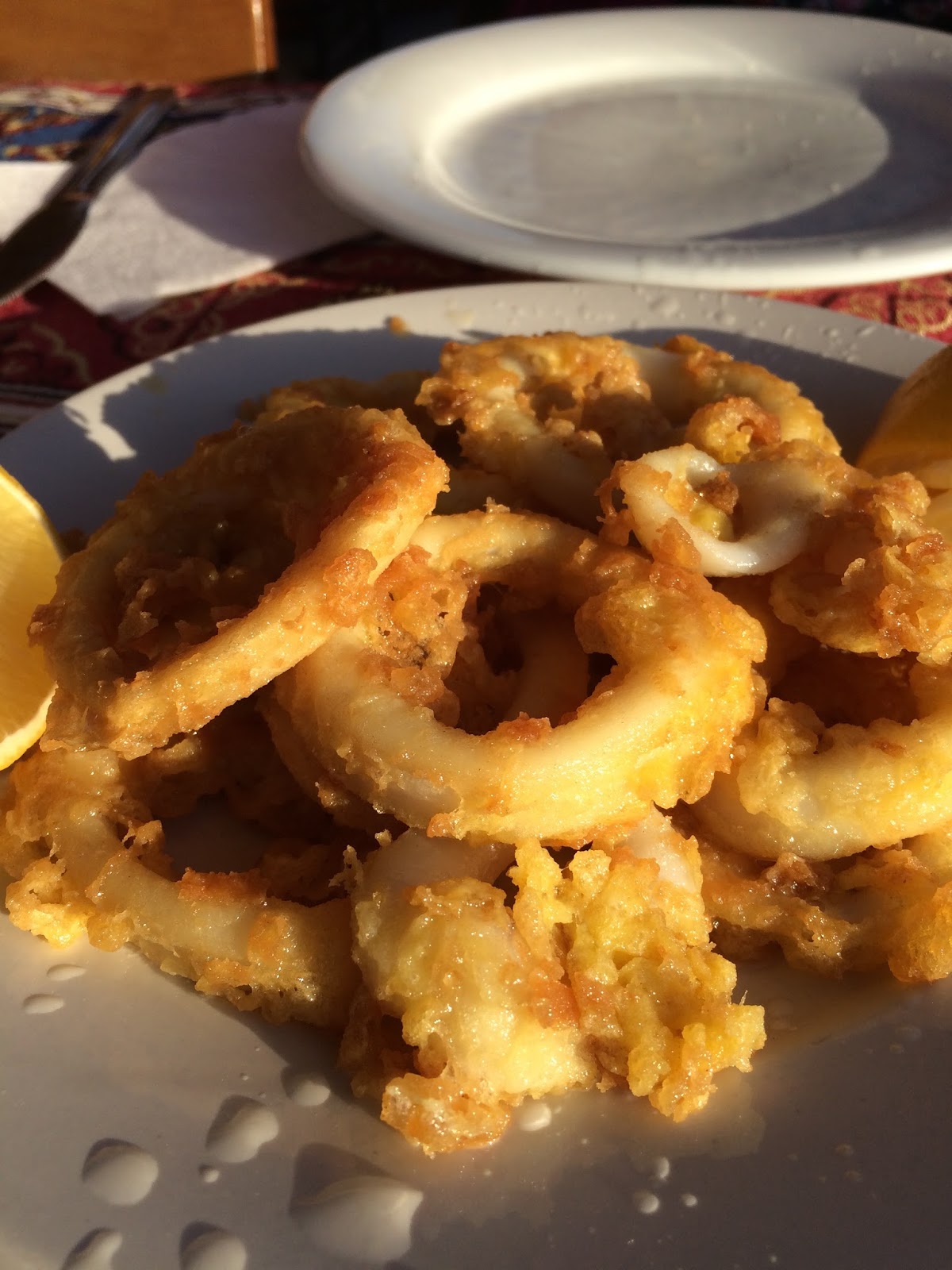
Fried calamari
If you are driving back from the beach, having happened to
skip lunch, and see a hand-painted sign screaming ‘FRIED CALAMARI’ from a
restaurant perched on the edge of a cliff above the tranquil turquoise sea of
the Mediterranean, you’re going to stop, aren’t you? A frivolous purchase but
certainly a worthwhile one.
 |
| Calamari from the Mediterranean Sea |
Grilled
fish
A treat on Republic Day in Kaş. Yes, I know the lamb shish
was as well; it was a special day, OK? We didn’t have much lunch so had plenty
of room to fit…just look at the picture below and judge for yourselves whether
you would have turned down grilled fish. I doubt you would. Unless you’re the
type who preaches ‘FISH ARE FRIENDS, NOT FOOD’ to your mates (from Finding
Nemo, if you’re wondering).
 |
| A light and lovely grilled fish in Kas |
Vegetarian
Hummus
A personal favourite of mine, which makes it slightly
surprising that we only had the chickpea-based dip twice during our time in
Turkey. Personally, I don't generally associate hummus as emanating from Turkey. Not sure why. Still, never one to turn down hummus if it’s available…
 |
| Hummus was often blended with olive oil and spices in Turkey |
Falafel
In spite of loving hummus and appreciating many other dishes
which use chickpeas, I’ve never boarded the falafel bandwagon. I feel it’s
aspiring to be something which it can never truly be: a burger. It’s like a
veggie burger. Which, as we all know, isn’t a real burger. Still, in smaller
ball-based form it’s quite nice, if a little dry. Remembering this blog is
supposed to take the form of a menu, I don’t feel I’ve sold falafel very well…
 |
| Fried falafel balls |
Turkish
salad and dips
A treat on Republic Day in Kaş. Well, not really: it was
actually the self-service part of our Republic Day meal before we realised that
amazing items such as lamb shish (see
menu: lamb shish) and grilled fish (see
menu: grilled fish) would be brought later. The eyes-bigger-than-stomach
syndrome, from which I’ve suffered all my life, led to a mile-high plate of
tzatziki, hummus, spiced tomato dips, beetroot salad, carrot salad, Turkish
yoghurt…I can’t remember all of it. See what else you can spot below. Turkish food
is fairly healthy, with salad items being included in almost all dishes. The
chips nullify that effect somewhat, however…
 |
| As starter plates go, this is XXL |
Dessert
Baklava
The king of the Eastern sweet shop. Being honest, it would
probably be the king of most sweet shops. This pastry, pistachio and sweetmeat
dessert is simply phenomenal. It probably has something to do with being
drowned in honey.
Baklava comes in many different forms, yet we thought the
simplest version was the tastiest. It’s popularity and deliciousness is reflected
in its price: one piece of regular baklava usually equates to 4TL (over €1,
just under £1). It’s priced per kilo, with the more pistachio-heavy forms being
dearer.
Don’t let the price put you off, though. This stuff is
fantastic. I’d happily skip the main course and eat a box of baklava instead.
 |
| Regular baklava in a 'pasta' (cake) shop |
 |
| A piece of baklava with extra pistachio |
Lokum
You may be more familiar with this if I call it ‘Turkish
delight’. Its proper name is lokum. It can be created with one simple flavour
(such as rose or pomegranate) coated with sugar or be made more complex with
the addition of extras such as nuts. These are the more expensive varieties of
lokum. The former are ready-cut into cubes, whereas the latter are originally
in long cylinders. The cylinders are then cut into bite-size pieces using…a
cleaver.
It’s not to everybody’s taste. In my opinion, the
sub-standard versions of the sweet are a bit too chewy and leave bits stuck in
one’s teeth. Though my teeth are terrible so this may just be a personal
problem. I like lokum: prefer baklava.
 |
| Rose-flavoured lokum |
 |
| Cylinders of the more exotic varieties are clearly visible in all bazaars |
Fruit
Lots of it comes from the local surroundings so fruit is
always a healthy, cheap option. Not always room for it if you fill up on
baklava though…
 |
| A fruit market in Kas |
 |
| A fruit plate, probably picked shortly before from a nearby tree |
Hot drinks
Apple tea
Turkish tea is normally taken sans milk, which can be a
problem at times for many a Brit abroad. What the country possesses which
others lack is a wide variety of warm, fruity teas which actually taste
acceptable when compared to the rubbish available in British supermarkets. Pick
of the bunch – as in, it’s actually lovely to drink – is apple tea. It also
comes in this delightful little glass. Lovely.
 |
| A lovely reward after pounding Istanbul's chilly streets |
Rose tea
Walking through the bazaars of Istanbul, you’ll find this
wide variety of strange teas. Whilst pretending to be interested in buying a
pair of socks, we were offered rose tea. The bazaar form of this is unstrained,
so the ‘rose petals’ (I’ve never seen any so small) were still in the plastic
cup. Refreshing, though I couldn’t drink a whole mug. That’s probably the same
with all of them, save for apple tea.
 |
| Alas, we never got to try 'love tea'... |
 |
| Rose tea: if you look carefully, you can see the roses themselves still in the cup |
Turkish
coffee
Coffee is also partaken differently in Turkey. It’s an
acquired taste, luckily one that I quite like. Turkish coffee is usually served
in an espresso-sized amount into a porcelain (lavish) or metal (less lavish)
cup. You will never see the bottom of this cup. If you do, it hasn’t been made
properly. The coffee granules never completely dissolve into the liquid; the
result is a dark, silty sludge at the bottom of your cup. Drinking this
is…well, not advised. I’m speaking from experience, here. What I will say is
that the liquid above the sludge is strong, aromatic and a perky pick-me-up in
the morning.
 |
| Often the smell would be sufficient to perk me up in the morning: strong stuff. |
Cold drinks
Fresh pomegranate
juice
Now this was something of a revelation. For Hannah, at
least. I struggled with its acrid taste so resorted to having sips of hers.
However, the energy and positivity I felt from one sip was stunning. Watching
this be made is also fascinating; it takes about four pomegranates being
crushed in a device which seemed more at home in a factory than on an Istanbul
side street to make a small cup. Yet it often cost 2TL: less than 50p! Amazing
stuff.
 |
| A plethora of pomegranates |
Boza
Those of you who don’t know of or like custard will find
this hard to appreciate. This is essentially a thick liquid which looks like
custard, flows like custard and…no, it doesn’t taste like custard. It’s a
fermented grain drink. But it’s surprisingly nice. The chickpeas floating atop
the custard imitator are a strange and unnecessary addition.
NB custard is amazing.
If you’ve never had it before, ignore everything that is on this menu and get
yourself a bathtub’s worth of custard. Mmmm…
 |
| Boza: a mini-meal in istelf |
Beer
Turkey is a secular state. Many of its citizens, however,
are not. Consequently, alcohol isn’t readily available as in many other
countries (certainly not the Czech Republic). It makes it more rewarding when
you find a non-tourist spot which sells the amber nectar. That’s certainly
worth appreciating more than the taste of Efes, Turkey’s national beer. We used
to drink this in Kazakhstan because it was better than their local beer. This
simply reminded me of how awful Kazakh beer truly was.
 |
| Czech beer > Efes > sewer water |
 |
| A lovely setting helps to offset any bland taste |
Wine
Like beer, Turkey also make wine. Like beer, Turkish wine is
incomparable to its western European counterparts in terms of quality. On
Republic Day, Turkey’s national day,
we were served wine from South America rather than southern Turkey. I’m no
aficionado, however, so was happy to the local red when the occasion came
about.
 |
| Examples of Turkish wine we didn't try |
Yes, we managed to have all of this (and in the case of
kebabs, many more than one) during our week away. To paraphrase that common
maxim: a döner a day keeps the doctor away!
Love you all
Matt