Hello everyone!
The island of Iceland has many incredible and unique elements to it. From volcanoes lurking silently under glaciers to gushing waterfalls flying off mossy or rocky mountains, there are many natural marvels seldom seen on our planet. There is something missing, though.
 |
| The Arctic Ocean |
 |
| Whales used to be a popular food here - less so now |
To put it succinctly, a lack of wildlife. Unsurprisingly really, given the harsh and varying climate experienced throughout a calendar year.
 |
| Sheep on the Snaefellsnes peninsula |
 |
| A guillemot perched on the very edge of the peninsula |
One mammal you can see is the biggest of them all: the whale. All kinds of whale, from blue to beluga, spend time swimming around the Arctic shores during the summer months.
 |
| Many species visit Icelandic shores |
 |
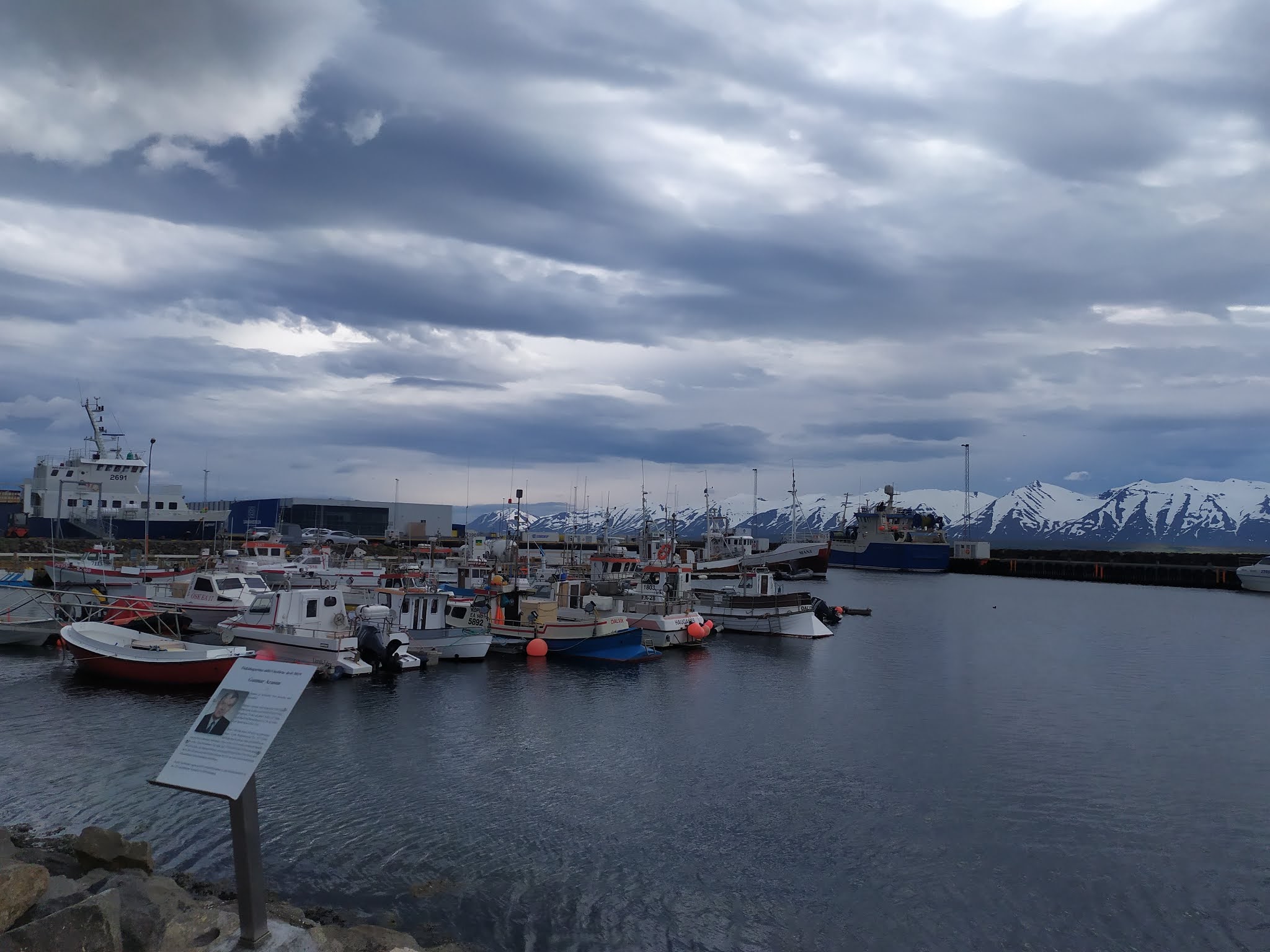
The port of Dalvik - here and Husavik are the most
popular starting points for whale watching trips |
Watching whales (and dolphins) do their thing is a popular activity, with the fishing village of Dalvik being a common boarding point. We boarded a boat, fully clad in red protective suits, and watched…
 |
| A sunnier and less windswept moment on the boat |
...and watched…
 |
| The crew look for the spout of water from the whale's blowhole |
...and eventually docked three hours later without any glimpse of, of even false alarm for, a humpback or blue or sperm whale. Not every adventure or safari ends with glory, and this was a windswept reminder of that.
 |
We weren't alone in our lack of luck - some friends went on
a smaller, more mobile rhib boat but didn't see whales either |
A popular and adorable bird which spends a lot of time in Iceland over the summer is the puffin. They flock to certain parts of the coast in their thousands to breed, keeping the same mate and burrow each year.
 |
| Turns out the airport was the closest I got to a puffin! |
One regular sighting spot is the black sand beach at Reynisfjara, on the south coast. We went...and didn’t see them. With the weather the way it was, I don’t blame them for hiding.
 |
| No puffins flitting around the basalt rocks |
 |
| Couldn't see any up there, either! |
Another site I‘d been recommended was Borgarfjördur, in the northeastern corner of the island. Alas, a change to our itinerary meant that reaching that remote outpost was simply not an option.
 |
From the Loch Ness Monster Lake it would
have been a minimum 3 hour trip |
This was a similar story for the arctic fox. Iceland’s only native land mammal is found in the northwest of Iceland, which was not a priority location for our group trip. Even though I have a bit of time to travel solo after my group trip ends, both these places are simply too far from Reykjavik.
 |
An internet image of an
Icelandic arctic fox in action |
So what did we see that could move and groove? Horses, for one. There are many Icelandic horses which roam freely among the fields and moss. They seem smaller than your average, and occasionally resembled oversized Shetland ponies.
 |
| Calling it a pony is apparently quite offensive |
 |
| These horses have a unique gait called 'tolting' |
Sheep are also a common sight. There are more sheep than people, just like I always tell people about Wales (I’m not sure if that’s true anymore). Iceland’s sheep seem to want to redress the balance a bit by trying their best to commit suicide on the country’s main road which rings the island.
 |
Sheep are free to roam anywhere - there's a funny story about
how they get divided among the farmers but I can't
remember enough detail to regale it here |
 |
| Probably has mates in Wales... |
The one new sight for me was an animal imported from Norway/Denmark centuries ago. The last time I saw one was on a Coca-Cola advert…
 |
| It's a reindeer! |
The reindeer all looked a bit scraggy to me: a little underfed and with a lot more body hair than I anticipated. Still, it's cool to see them and their funky antlers in the flesh. No red nose in sight, before you ask…
 |
| There are up to 7000 reindeer found in eastern Iceland |
We did also manage to see a couple of seals on the south coast. The most common species are the harbour and grey seals. Once again though, the main seal breeding grounds, which I visited when I went to Snaefellsnes, were eerily empty.
 |
| This seal was hanging out at the iceberg lagoon of Jökulsárlón |
There has to be a link between a lack of sightings and human activity, though people I met in Reykjavik on my last couple of days in Iceland did get lucky with seeing puffins and whales. One possible reason may be that many of these animals formed part of an Icelander’s diet back in the day.
 |
| A langoustine baguette in Iceland's 'lobster capital' of Hofn |
 |
| Char is a common menu choice, and very tasty |
Less so now, with any of these less conventional meats and fish being eaten only by tourists. After a bit of research I felt comfortable eating reindeer in the form of a burger, as their numbers seem stable. It tasted OK, though the place slathering it in barbecue sauce could be interpreted as them trying to hide its true flavour.
 |
| No McDonald's in Iceland, in case you were wondering |
No attempts of flavour deception are made on the other thing I tried, however. Hákarl is a notorious dish which is generally eaten locally once a year to celebrate the end of winter. You may know it as fermented shark.
 |
The species is called the Greenland Shark,
and lives to be hundreds of years old |
It comes in little balls and is served in a sealed glass container with a shot of Brennevin on the side. You realise why it's sealed when you open the jar. The horrendous scent of ammonia invades your nose and makes many recoil in horror. Others brave the reminder of cat urine and put a small ball on a toothpick, chew it five times and swallow.
 |
| Its slow metabolism means it is poisonous unless fermented |
I don’t care how much of a man it makes you, or how much people respect you for eating it all. It wasn’t nice. The shot, which you have after eating them, arguably tasted even worse! I always get a bit torn about the ethics of eating foods like these and where I should draw the line. This probably falls on the side of regret. Sorry, shark.
 |
It is buried in the ground for up to five months, with ocean water
sinking in alongside it, before further fermentation above ground for 3-4 months |
No trip is perfect and nothing is guaranteed. Just to be able to even have the opportunity to see some of Iceland’s wildlife is a privilege that I shouldn’t forget. Unlike the smell from the hákarl, which I want to forget forever.
 |
| Fish jerky - surprisingly nice dried haddock! |
 |
| There's a whale out there somewhere... |
 |
| Seal you later! |
Love you all,
Matt