October 24-26
Hello everyone!
The place where east meets west. The destination where two
continents join. The end of one civilisation and the start of another. A mix of
a myriad of cultures. Clichés abound about Turkey’s largest city: Istanbul.
It’s also a place which very few people have a bad word to say about.
 |
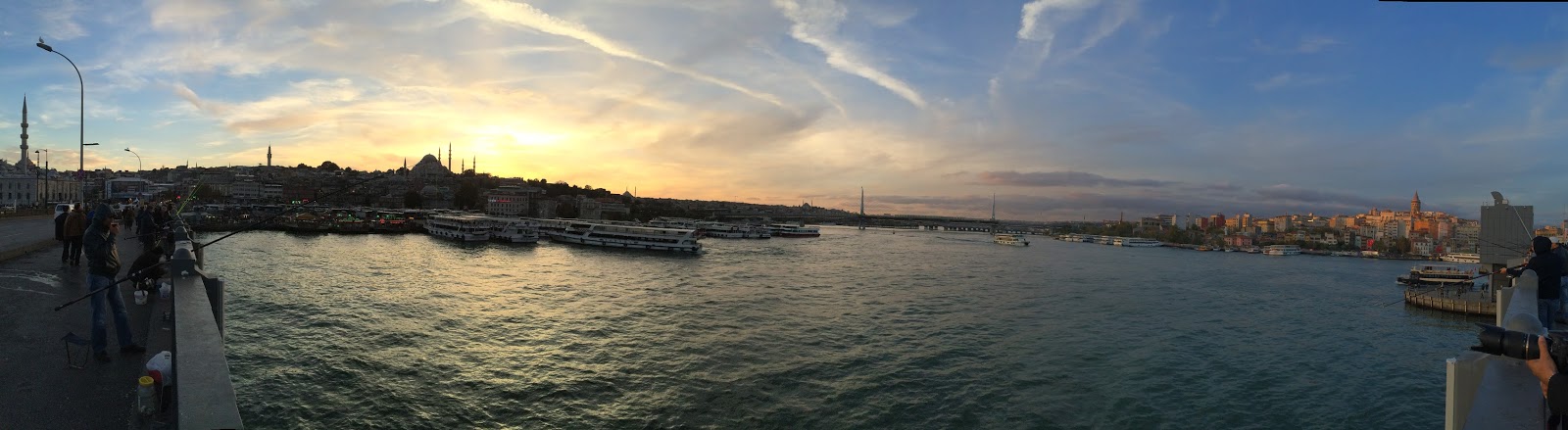
| The Bosphorus, which divides Istanbul into three distinctive areas |
It’s been a while since I was here. Seven years, in fact. In
2008, when I previously spent time in Istanbul, I had stitches removed from my
head and was trying to live on scraps. My travelling methods have changed slightly
since then; I was fascinated to see whether this metropolis had modified as
well.
 |
| A man shaving a doner in 2008. When prices were much lower... |
 |
| Walking through the Grand Bazaar in 2008. I have enough money to buy more than a bowl this time... |
Of course, many of the main attractions of Istanbul were
here when I last visited; indeed, they've been around for far longer than I
have been on this earth. One of the oldest is the world-renowned Hagia Sophia,
the current and third version of which was built in the sixth century.
 |
| Hagia Sophia |
 |
| The beautiful interior of Hagia Sophia |
This beautifully rustic building, with its fading red
exterior and seemingly crumbling brickwork, was originally constructed as a
church by an Emperor called Justinian. The reason I say it was a church is because of what happened here in 1453; an event
which shook the Christian world at the time. The sacking of Constantinople.
 |
| Hagia Sophia from the front entrance |
 |
| An artistic interpretation of the conquest of Constantinople, what Istanbul used to be called |
The Ottoman conqueror, Sultan Mehmed II, converted the
church into a mosque. It remained an active mosque until 1935, when it was
changed into a museum by the founder of modern Turkey, Mustapha Kemal Ataturk.
 |
| An example of Islamic-styled decoration in Hagia Sophia |
 |
| The interior of Hagia Sophia |
What I found fascinating is how many Christian elements were
maintained in the Hagia Sophia, even when it had been a mosque for hundreds of
years. Mosaics depicted biblical events and people are still visible on the top
floor, as are notes from one of the synods from the 12th century. It
shows an acceptance and tolerance of other religions.
 |
| The symbol in the corner is a Christian symbol |
Looking out of the southern-facing windows will explain to a
visitor one of the main reasons why the Hagia Sophia is no longer active as a
mosque. It doesn't need to be when one of the largest and most famous mosques
in the world is across the street: the Blue Mosque.
 |
| The view of the Blue Mosque from Hagia Sophia |
 |
| The Blue Mosque |
This apparently is only one of two mosques in the world
which has six or more minarets. The other one is in Mecca: the holiest of all
Islamic sites. The Blue Mosque is therefore a big deal and has been since its
construction was completed in 1616. As with all mosques, certain clothing has
to be worn or removed prior to entering. Animals are also forbidden from
entering, in spite of this dog’s best efforts.
 |
| The dog eventually tired of queueing |
The idea of the mosque and its scale was to emphasise
Islam’s superiority over Christianity and its size certainly screams dominance
and power. Its central dome is 43 metres in height and almost 24 metres wide.
The mosque itself is adorned with over 20,000 blue tiles, which is why the
Mosque of Sultan Ahmet has a more common name.
 |
| Inside the Blue Mosque |
 |
| The blue tint is very noticeable inside the mosque |
At the last count, in 2013, there are 3113 active mosques in
Istanbul. Another of the ‘heavyweight’ temples is the Süleymaniye Mosque in the
old city district. This has breath-taking views of the Bosphorus River which
dissects the city.
 |
| The Süleymaniye Mosque |
 |
| A view of the northern, more modern side of European Istanbul from the mosque |
These three attractions lead scores of people to Istanbul,
even in October. I was surprised by the plethora of tourists who are visiting
the city even when the temperature drops to single figures and the rain starts
to fall. Interestingly, Istanbul receives more annual rainfall than London. No
stigma attached here, though.
 |
| The line to enter the Basilica Cistern |
 |
| Dark clouds hovered throughout our trip; luckily for us, it only rained once. |
Millions of tourists visit but there are more than enough
locals to make this metropolis seem like a swarming beehive. Approximately 15
million, in fact. 3 million pairs of feet each day trample along the streets
leading to the modern ‘city centre’ of Istanbul: Taksim Square. We visited one
evening in the aftermath of a football match but that event deserves a blog of
its own. All I’ll say for now is that it is reminiscent of a major city centre
street in the UK. Shops like Mango, McDonald’s and LC Waikiki aren't readily
available in other parts of the country. Cosmopolitan would certainly be an
accurate description.
 |
| A particularly busy time on one of Taksim's main streets |
One aspect of modernity and globalisation which didn't quite
work whilst we were here was the time. In that it was difficult to know what
the time was. The clocks in most of
Europe reverted to their standard winter time during the weekend of our visit.
It was thus to our surprise, and at times dismay, that we would change from a tram which stated 15:38 and embark on one which read 14:42. It transpires that this year, and only this year, Turkish
folk are changing their clocks two weeks later than the rest of us. Clearly
half of the local population weren't aware of this…
 |
| Many locals were aware that DST ends in November, but many were not... |
 |
| It's because no one knows the time, that's why! |
Some aspects of Istanbul are modern, yet the city retains
much of its traditional charm. The sight of dozens of people fishing of the
relatively new Galata Bridge is heart-warming. I remember vividly from my
previous visit being encapsulated by these old men – and now women – who spend
their day casting off into the river below, avoiding the mass of boats whilst
hoping a fish will take the bait from within the choppy waters.
 |
| All of these people are fishing, their lines centimetres apart |
 |
| Fishermen on the Galata Bridge |
Traditional shopping has been maintained in some aspects
(the Spice Bazaar) though in others it has been usurped by the desire to hunt
for the tourist dollar, euro or rouble (the Grand Bazaar). I’ll talk about
these in another blog.
 |
| The outskirts of the chaotic and cacophonous Spice Bazaar |
 |
| The Grand Bazaar: at times reminiscent of a western shopping mall |
This is the thing about Istanbul. There is so much to see,
to do, to sample. So much to experience, some of which can be intimidating
whilst other occurrences bring sheer joy. We were around for the best part of
three days; I feel like we barely scratched the surface. What an incredible
city of contrasts. Clichés are often based in truth and I will certainly agree that
you can have completely different experiences within two or three miles in the
same city.
 |
| The old-school method of transporting large goods |
 |
| A five minute walk from the buzz of the Blue Mosque we found this delightful cafe and dog, which we named Sully. After the founder of the mosque, Sultan Ahmed. Duh. |
 |
| A wall in the modern part of the city adorned with traditional mosaic designs |
I've been asked a few times where my favourite places are in
the world and I've always listed Istanbul in my top five based on my
experiences here when I was twenty years old. Returning with a shred more
maturity and a more worldly perspective, I can safely say that Istanbul would
still rank just as highly as I approach the end of my twenties. Words can’t do
everything about this city justice: just go. Go be harassed in a bazaar and enjoy it. Go try some bizarre food and savour it. Don’t check for the possibly
incorrect time; instead, allow time to disappear around you as you immerse
yourself in Istanbul.
 |
| A multi-coloured staircase hidden within crumbling high-rises |
 |
| The old city at sunset |
 |
| Savouring Turkish coffee: food and drink get their own blog as we tried so many different things |
Love you all
Matt