December 24-26
Fa-la-la-la-la, oh and lions.
 |
| Black rhino |
 |
| Leo (NB: may not be his real name) |
And these…
 |
| Elephant |
 |
| Zebra |
 |
| Cheetahs |
As well as these…
 |
| Ostriches |
 |
| A herd of springbok |
 |
| Oryx |
Not forgetting these…
 |
| Giraffe |
 |
| Terrapins |
 |
| Impala |
All of these – and many, many
more – can be found in Namibia’s pride and joy: Etosha National Park. 117
different mammals, in fact. Situated in the north of the country, Etosha covers
a little over 22,000 sq km of wildly changing landscape. It used to cover
105,000 sq km but boundary changes throughout the twentieth century gradually
limited its area.
 |
| A family of giraffes in Etosha National Park |
 |
| This is roughly the current size of the park on a map of Namibia |
The main non-moving feature of Etosha is its pan. The land surface, a dull and uninviting grey without sunlight, used to house a large lake, which was possibly the largest inland lake in the world at the time. About 12 million years ago, a tectonic shift rerouted the inflowing rivers towards the Atlantic Ocean, resulting in Etosha’s lake evaporating into the air. The salt remained, giving much of the national park a lunar-like look. Apparently it can be seen from space!
 |
| A journey of giraffes (yes, that is the collective noun for giraffes) crossing the pan at Etosha |
The changing weather makes for some spectacular vistas, too…
 |
| A lion enjoying the sunset near Namutoni in eastern Etosha |
 |
| A dark sky, often pierced with bright forks of lightning, near Okaukuejo in western Etosha |
The fact that the land is so bare makes the abundance of
wildlife even more startling. Their survival is due to Etosha having several
waterholes dotted around its vast space. The animals, needing to drink to
survive, are often found at these sites.
 |
| Giraffes contorting their bodies to drink from water holes is an amazing sight |
 |
| A dazzle of zebras (Google it if you don't believe me) drinking simultaneously from the water hole at Okaukuejo's campsite |
The campsites in the national park are situated next to some
of the major watering holes, allowing visitors to sit back, relax and watch the
different creatures wander in to drink. We actually didn’t see many animals at these
sites, though it was pretty special when we did…
 |
| The water hole at Okaukuejo at night, where we saw a mother and baby rhino drink |
This lack of action can possibly be explained by our group
using up all of our luck on our drives around the park. Mere minutes after
leaving our first campsite, we came across an animal I’ve never seen in the
wild before: the black rhino.
 |
| A rhino being 'black' or 'white' is nothing to do with skin colour - the main difference is their lips, showing their respective eating habits. |
You may notice that the feature most synonymous with the
rhino, its horn, is missing. This, we were told, is for its own protection.
Poachers desire the horn for a variety of purposes (our guide said alternative
medicine is the main reason) but kill the rhino in order to obtain it. When
young, the rhino is thus tranquillised and has its horn removed by park
conservationists. If the horn isn’t present, the poachers won’t kill it. One
hopes…
 |
| Black rhinos can weigh up to 1,400 kilograms - I'm about 60... |
 |
| Black rhinos have a pointed lip to pick fruit and leaves from branches |
Another animal I saw in the wild for the first time was the
ostrich, with its bizarre neck often shaped like an S as it strutted around the
plains. We got close to them but were even closer to a scorpion which we found
scuttling around at breakfast one morning.
 |
| Ostriches here can move at 50 km/h - elsewhere they are even faster! |
 |
| There are apparently 59 species of scorpion in Namibia - I have no idea which one this is |
Rhinos are big beasts but Etosha is home to even larger
animals. We saw seven elephants, including one calf. All of the elephants we
saw were eating, which is unsurprising given that an adult has to consume 240
KILOGRAMS of food every day. This is because it only digests up to 60% of that
amount.
 |
| The ears of an African elephant are larger than those of its Indian counterpart |
 |
| I was taking pictures and videos on my phone - the quality pictures on this blog are from Sami and Thomas from my tour group! |
Our most interesting elephant encounter was with the second
one we saw. It seemed…annoyed. Our guide described what we see in the video
below as ‘redirected aggression’ – it was angry at us so took out its ire on
the poor tree…
 |
| Dumbo - angry! |
I never get tired of seeing these animals as there’s always
something different happening. From the giraffe starting to do the splits in
order to drink to the mother cheetah swivelling her neck whilst her cubs lay
lazily in the shadows, there were an incredible number of incredible moments.
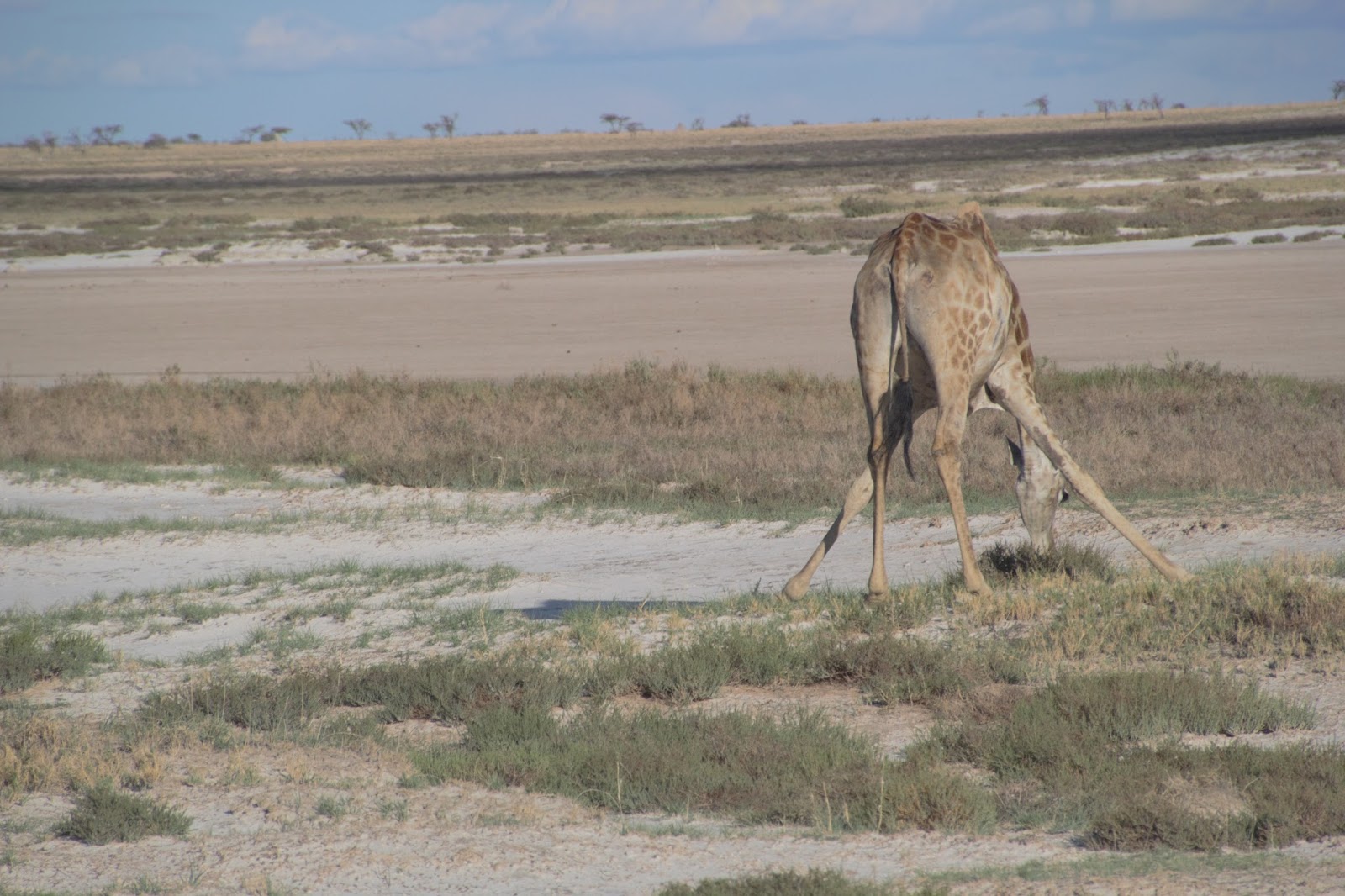 |
| Giraffe doing the splits: priceless |
 |
| A cornucopia of cheetahs (OK you got me - it's a COALITION OF CHEETAHS!!) watching potential prey |
And I haven’t even got to the most heart-stopping encounter
yet. On our first game drive, we decided to try one more water hole before
sunset. We rocked up to the water hole with nothing visible on its edges. Our
guide then spoke. Just one word.

“Lion.” Through the window we peeked. A male lion, lying in
the middle of the road, less than ten metres in front of us.
 |
| Male lions are notoriously lazy - still, you wouldn't mess with him... |
Then he got up. You aren’t allowed to leave your vehicle in
Etosha so I’d spent much of my afternoon hanging out of the window getting
pictures. As the lion began to stalk around our bus, I opted to keep my arms
and legs firmly inside the vehicle. Most of the time…
 |
| I often resorted to hanging out of the bus, holding onto the roof with only legs inside. Not with the lions about... |
It got better. We soon spotted that there was an animal at
the watering hole after all. Another lion. He decided to come and join us.
 |
| A lion's roar can be heard up to 8 km away |
It then got really interesting. Both lions seemed to be
marking their territory, scuffing their feet in the dusty ground and staring
intently at each other. Unfortunately we had to leave at this point as the
campsite gates closed at sunset. If we’d stayed a little bit longer, we would
have seen the next instalment – we also would have spent our whole night with them,
which was less desirable.
We saw another lion the following afternoon. It was
protecting a kill, what seemed to be a gnu or blue wildebeest. The lioness then
started to wander off, only to return when a jackal circled around to try and
scavenge some extra lunch.
 |
| The Day of the Jackal? Not quite... |
It is captivating simply watching all of these special
animals simply going about their daily routines. With a backdrop so diverse it
seems other-worldly, Etosha National Park is a stunning place to see your
Christmas wishes come true.


Love you all
Matt


