Monday, 8 January 2018

Ethiopia – Feed the World

December 28-29

If I were to say Ethiopia to you, what would you think of? Maybe not this…

Fruit stall in Addis
Ethiopia made global news in 1985, when a horrendous famine ravaged the country. It was the purpose behind Live Aid. Famine and crop failure has been a problem here for time immemorial. The 1985 famine, however, was the culmination of three failures across the country and exacerbated by politics, initially the West’s reluctance to aid a socialist country and then Chairman Mengistu’s refusal to help the Tigrai province, near what is now Eritrea in the north.

Michael Buerk's BBC report sent shockwaves around the world
in 1984

One in five Ethiopians were affected by the famine

This is what many people think of when they hear ‘Ethiopia’. Though famine does happen about once a decade, they are often in isolated areas in the north and east. Ethiopia produces lots of amazing food, and was a major factor in me wanting to visit.

Talapia is a fish found in Ethiopian lakes
Traditional Ethiopian food is said to be unique in Africa, and I have never had anything like it. The closest dish I can think of is a south Indian thali, in that there are lots of different little dishes and one bread-type food on which to place morsels of the other dishes. Even then, that’s quite a tenuous link.

A traditional meal, consisting of different wats and tips

That bread-type dish is called injera, a soft, flat, pimpled flatbread made of tef, an endemic grain. It is spread very thinly, like a pancake, meaning it can be easily torn to grab the mini dishes which sit atop it. These are necessary – injera is bland on its own, reminiscent of sourdough. It’s also required as it works as your cutlery. You pull a piece of injera, grab a bit of the little dish, twist slightly so it can close up in your fingers (right hand only), and then pop it into your mouth.

Injera gluten-free and more calcium than a glass of milk

It’s the mini-dishes that make Ethiopian cuisine so delicious and different. Full of different herbs, spices and colour, these sauces – called wats – bring your mouth to life. My favourite one of these so far is called something like shiro niter kibbeh, which is chickpeas cooked in clarified butter. They may also use meats in these dishes: tips.

One of these meals is very filling - I get the feeling they put
 extra rolls of injera on the side for a challenge
One meat you won’t find is pork, due to the country’s strong religious nature. This extends to eating certain foods on certain days. Ethiopian Orthodox Christians, a majority in the country, have to fast for many days of the year. I couldn’t find an exact number: different sources range from 190 to 208. Ethiopian Orthodox will fast for the forty days before Christmas and up to 55 days before Easter, in addition to Wednesdays and Fridays.

Cubed beef is a popular bar snack - I can't remember its local name
Fasting is different to that of other religions. A fasting ‘day’ finishes at 3pm, and no meat products are allowed at all on those days. A consequence of this is that much of Ethiopia’s cuisine is vegan.

This was called 'fasting food' on the menu: completely vegan
In fact, many things are different here. For one, Christmas hasn’t happened yet. It’s on its way, as you can see from the pictures below, but it will happen on January 7th. This happens in Russia, too – they follow the Julian calendar, rather than the Gregorian calendar followed in much of the world.

I guess Santa doesn't have to deliver to much of Ethiopia on
December 24th - should save him some time?

Christmas market at the Piazza
When walking around with a local who ‘wanted to practise his English’ (he actually wanted me to buy him a book, which then gets returned to the shop at a slightly reduced rate so he can pocket the money), I ended up seeing a street cordoned off by police and full of people wearing white. They were celebrating Kulubi Gabriel – a festival for St. Gabriel.

Church of St. Gabriel

Pilgrims dress in white and come to celebrate Gabriel's
special period
Some differences regarding dates and times seem unique to Ethiopia. New Year here is on September 11th – I know that from spontaneously going to the Ethiopian restaurant in Malawi on that date. Even more interesting is the fact that many Ethiopians tell the time in a completely different way to how Westerners do. They use a 12-hour clock, with 0:00 being sunrise (i.e. around 6am in ‘my time’). Our ‘midday’ is thus 6am in this system. Obviously, this wouldn’t work in the UK – we’d only have 8 hour days in a Scottish winter!

The time on the TV says 7:17 - I watched this
whilst eating my lunch
Oh, and the year is 2010. Meaning I was born in 1980…


The language is also unique. Amharic has a script that often looks like stick drawings of people; it’s also very difficult to translate into the Roman alphabet. Some phrases are simple – ‘ishi’ can mean ‘thanks’ or ‘OK’. Others, such as the formal way of saying thank you, are a bit more of a challenge.


If you say 'I'm a Single Lady', it sounds vaguely similar...
One of the easier Amharic words is ‘buna’: coffee. Coffee happens every day and is an Ethiopian institution – after all, they have claims on being the first use the bean.

Ethiopia is the world's fifth-largest coffee producer
The legend behind coffee’s discovery is brilliant. A young boy saw his goats going wild after eating some leaves. He then tried some, became hyperactive, and ran to tell monks in a nearby monastery. They basically called him evil and threw the berries into the fire, where they of course roasted and released their intoxicating smell.

The beans are roasted on a pan
Today Ethiopians drink Arabica coffee in espresso form and often serve it in an elaborate ceremony. The burning incense brought Indian temples to mind: until the beans start to burn and char in the pan. I was told that it’s rude to drink fewer than three cups of coffee in a sitting, as it’s mainly a time for chatting; most foreigners are excepted, and I was feeling enough of a buzz after one. It’s not quite as strong as espresso and reminded me more of Turkish coffee, albeit without the silty dregs at the bottom of the latter.

The beans in their different phases

The green leaf is added to create flavour

No matter what time it is – Western or Ethiopian – coffee is a way of life here. After the bucket-loads of delicious food, it’s a good way of ensuring one doesn’t fall into a food coma. Selfishly, I hope that, a bit like Korean food until it exploded a few years ago, Ethiopian food doesn’t become a global phenomenon – more for me!

Strawberry, orange, mango, papaya, avocado,
pineapple, banana...


Love you all,


Matt

Sunday, 7 January 2018

Ethiopia – Where It All Began

December 28-29

Hello everyone!

For the next 10 days I’ll be traversing the large land of Ethiopia: Where It All Began.

Ethiopia's history: old

The lion is one of many Ethiopian symbols

That’s one of the more common tourism slogans for Africa’s second most populous country. I was starting in the biggest city: the delightfully-named Addis Ababa.

Addis became the capital in 1886

Up until now, my experience of Ethiopia’s capital city has been restricted to its airport, which is currently undergoing major renovation. At least that’s the justification for having portakabin toilets for the last 18 months.

Addis Airport: a work in progress

The construction is spearheaded by Asian investment, a common theme both in the city and across the African continent. The skeletons of tall buildings are beginning to dominate Addis, with some looking more secure than others.

Scaffolding which you're unlikely to see in Europe

The new national stadium

With help from the Chinese government, Addis was able to create its own overground system, a vital artery if crossing the metropolis. I boarded it once – after feeling like a sardine for three stops, I disembarked and decided to use my feet.

The light rail line started in 2015

Very crowded aboard the green line

On a map, much of the city will seem walkable. Distances between main points of interest don’t seem particularly onerous; the international airport is only about 5 km to the south. What the 2D map won’t reflect, however, is the hilly nature of the city. Being over 2,300 metres above sea level also contributes to walking becoming quite a chore, as does the fact that it’s 28’C in winter. Pollution is also an issue, with a layer of smog being clearly visible early in the morning.

All downhill on Churchill Road
Downtown Addis

In spite of all of this, I spent the majority of my time in Addis on foot, stomping along the pavement (and occasionally the road when this didn’t exist) to get a feel for the city. A few times I was joined by people who ‘wanted to practise their English’ or were ‘walking in the same direction as me’. I never felt threatened, though aware of the city’s reputation for pickpocketing, and actually saw some interesting places as a result – I’ll talk about them in the next blog.

Banana sellers rumbling down the hill

The Church of St. Gabriel

The one exception was when I took a taxi from the National Museum back to my hostel. There are a few modern taxis here, coloured yellow and green, but the vast majority are blue Ladas. A bone-shaking 10 km ride in one with a friendly driver called David reminded me of using cars like this in Kazakhstan on a regular basis.

The seatbelt didn't work, which made the ride interesting

A line for petrol

The number of Ladas may be linked to Ethiopia’s more recent past. For 13 years, the country was under the control of a left-wing military junta known as the Derg, with a man called Mengitsu Haile Mariam at its head. He then ‘democratised’ Ethiopia in 1987 and Ethiopia held elections, though the only nominees were Derg members. Links to other communist countries, such as Cuba and the USSR, are visible at the Tiglachen Memorial, which commemorates Ethiopian and Cuban soldiers who died fighting Somalis in 1978.

You have to pass through a police check
before gaining access to the monument

Marxist designs adorn the area

During this time the ‘Red Terror’ swept across Ethiopia, a mass purging and execution of those opposed – or not animatedly celebrating – the new Ethiopian order in 1974. It lasted four years, reputedly killed over half a million people (including a purging of many Derg officials in 1977), and was initiated by Mengistu throwing three bottles with a red liquid (possibly blood) into a large crowd, saying that this is what would happen to counter-revolutionaries. This picture, and many more, are found in the eponymous museum at Meksel Square, where that speech took place. Quite a chilling museum, and disturbing to me that I’d never heard of it.

Red blood being thrown by Mengitsu

A picture of a protester in the Red
Terror Museum
The National Museum, definitely worth a visit if you stop in Addis, traces the country’s past back way further than this time. The slogan I used at the start is a hint at the length of Ethiopia’s ‘human’ history. Ethiopia is where one of the oldest, fullest human skeletons was found: Lucy.

Lucy is an Australopithecus

A replica of the 3.2 million year old girl

The museum does a great job charting the progress and potential links between Homo Sapiens (us) and other hominids, as well as between humans and other animals. It also shows the remains of many species which are now extinct; incredibly, they suggested that 99.9% of species that have ever lived on Earth are extinct. Mind-blowing.

A comparison of ankle bones in mammals

The cranium of an extinct relative of the elephant

They have replicas of some of the more famous archaeological finds in Ethiopia and Eritrea, most of which come from the Afar region in the northeast of the region.

The story is that Lucy is named after a Beatles
song, which was being played in the camp upon discovery

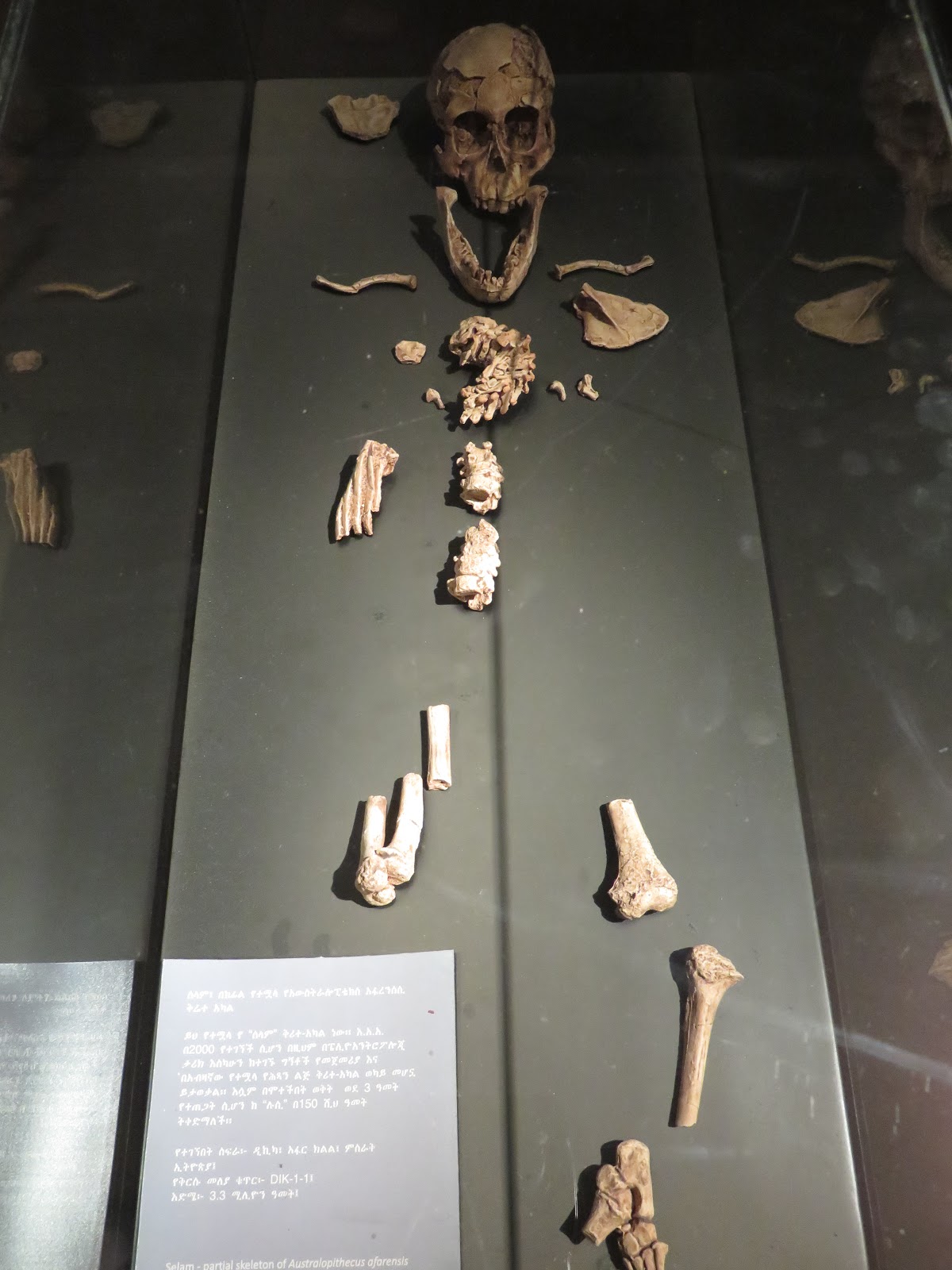
Selam, the remains of a three-year-old who
died 150,000 years before Lucy

The land within the borders of modern-day Ethiopia is steeped in an incredible amount of history, some of which can be seen in its sprawling capital. Much of its recent past has been harrowing, and even now many people find Addis to be a challenging, chaotic, polluted mess. It is all of those. I also found it to be safe, colourful and looking forward. Then there’s the food…


Love you all,

Matt

Monday, 27 November 2017

U.A.E. – Comparing the incomparable

November 23-26

Hello everyone!

Like the children we work with, the majority of teachers are always striving to develop their skills to make a positive difference to their charges. Sometimes this involves scouring the internet; other times it involves going to teacher conferences in the Middle East. Not that often, admittedly, but an opportunity that I’ll happily grasp.

The Dubai Fountain, viewed from floor 124 of the Burj Khalifa

Burj Khalifa...or giant laser??
 Being on a ‘business trip’ of sorts doesn’t mean that fun is restricted, however. Indeed, the way our flights worked meant that we had two full days to explore Dubai and experience this city-state’s glitz and glamour. And its appalling driving…

The yachts docked in Dubai Marina


I’ve been to this emirate before, in 2012. The blogs about it can be found around here and here. What I was particularly keen to do was compare it to my current home of Malawi. Malawi, which often can’t power the fridge in my house, let alone do this to its buildings…

If only they could keep my milk cold...

Putting this on my head was an
interesting - and fruitless - selling method

The change of pace is frightening. Dubai is whizzing down an eight-lane highway in a Ferrari while Malawi is plodding along on foot. So many new skyscrapers have shot up since I last laid flip-flop on the Arabian sand. So many more are being built, the cranes illuminating the sky like elongated fingernails.

Malawi's main motorway is one lane in each direction

The cranes on the left are working on new structures
on the Palm Jumeirah, Dubai's largest man-made island
  
These are tall but shrivel in comparison to the largest building of all (for now): the Burj Khalifa. 828 metres tall. That’s taller than the highest point of Belgium, Senegal and Uruguay. Almost 200 metres taller than the next largest completed building, in Shanghai. Oh, and about 792 metres taller than Malawi’s tallest building, Kangombe House.

A model which is not 828m tall

Don't underestimate how hard it is to fit
the entire Burj Khalifa into one shot
  
Going up the Burj Khalifa generally needs to be booked in advance, which is why we didn’t rise up to the clouds five years ago. This time, I was prepared…


You can’t go to the very top – there’s no way of doing that, short of being an urban climber. There are two options, both of which take you higher than any structure outside of Asia apart from One World Trade Center in New York. You can go to floor 124 or floor 148 of the Burj Khalifa.

Just look at the shadow it casts!

The temperature difference between the top
and bottom is normally about 6'C


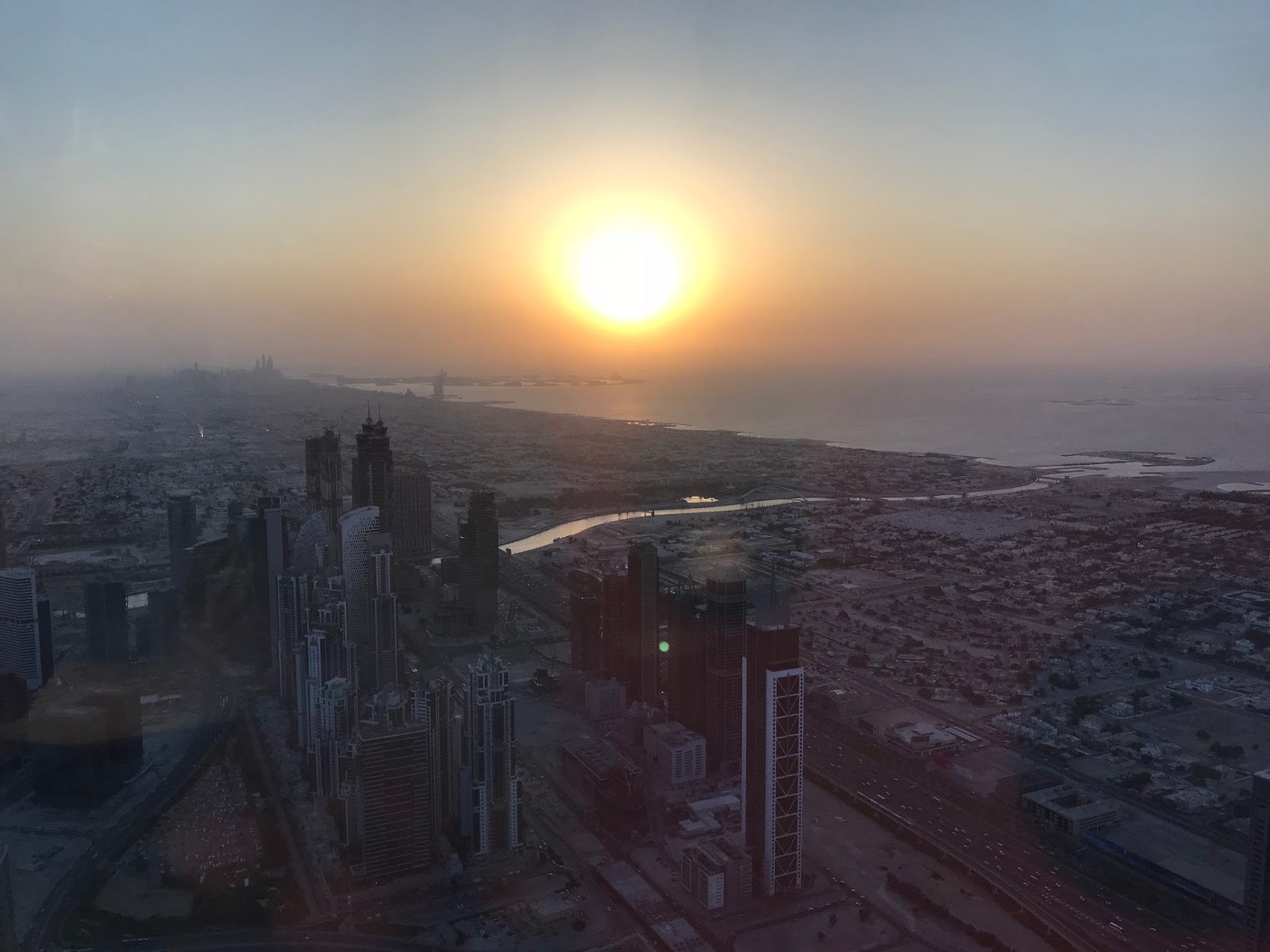
At 455 metres tall, the 124th floor seems plenty high enough. We timed our ascent so that we could witness the sunset.


The northeastern side of the city
  
Very impressive it was, too, though the pollution haze which lingers around Dubai made the Sun disappear before sinking into the Arabian Gulf.

At one point you are almost looking down on the Sun

Pondering life - or why they need so many
skyscrapers
 - as the Sun sets to the west
  
Soon, as dusk turned to darkness, the landscape transformed in a way unimaginable in Malawi. It was as if someone had found the magical switch that turns on all of the Christmas lights. Dubai was illuminated once more – just this time, the light was coming from the buildings, rather than the Sun.

The green lights belong to Dubai Mall, the largest mall
in the world by total area

Lights of many colours radiate in the
gathering darkness
  
Pretty much directly below the Burj Khalifa is a body of water which does its best to be an eastern version of the Bellagio in Las Vegas. From 455 metres above, it’s a very different perspective to that on ground level. I found it fascinating that the water seemed to hardly rise at all, simply because of the extraordinary height from which we were witnessing the show.

The water rises to a height of 150 metres - half the height
of the Shard in London


On the ground, it’s accompanied by music (we were told it can range from traditional Arabian music to…Enrique Iglesias). Up on floor 124, the water spurts seem to sway and soar in silence, like dancers from a faraway planet.

6,600 lights are used in each show, which lasts between
five and ten minutes

Shows are every 30 minutes, starting at 6pm
 The tower and water show are merely two examples of Dubai’s opulence and extravagance. Its other icon is the Burj Al-Arab, the infamous ‘seven-star hotel’. You can only enter if you book a room (over $2000 a night), go to a supposedly sub-par restaurant or have possibly the world’s most expensive afternoon tea.

Roger Federer often plays exhibition tennis
on the helipad of the hotel

The nearby public beach provides great
views for sunset
  
The marina area seems transformed from the last time I came to Dubai, almost a city in its own right due to the sheer number of cloud-piercing towers which dominate the small beaches below. Once again, at night it’s transformed into a festival of lights.

The marina isn't actually on the sea - it's behind
the skyscrapers

The Jumeirah Beach Residence (JBR) consists of over
40 towers and 6000 apartments 
  
Dubai’s marina comes complete with a large shopping mall, featuring stores which one would only imagine seeing in the UK.

Mum's favourite!

The number of shopping malls is simply staggering. How they all survive, let alone thrive, is beyond me. Maybe events such as Black Friday (yes, that happens here too) contribute to people making their bags and cases overflow with just about anything you can imagine. The fact that the prices are often sky-high in the first place seems to be ignored.

But if you don't need it, it's not a bargain

Flags were draped across the Mall of the
Emirates in preparation for National Day, on
December 2nd
  
The malls themselves are about so much more than shopping, though. Ever seen a shark on the second floor of Gateway Mall in Lilongwe? Or penguins in the Trafford Centre in Manchester? I wasn’t overly impressed with the fact that the owners have trapped creatures from faraway lands into a zoo-like existence in the desert. I also seemed to be in the minority.

That is a shark, and there were scuba divers in the aquarium

The penguins are found in Ski Dubai, an indoor ski slope in
the Mall of the Emirates with a temperature of -6'C
  
One thing I was impressed with was the medical care. Well, eventually. I went for a pre-arranged consultation at 9am and was told at 8:45am that the doctor was in surgery until 2pm. Anyway, an ear infection which I’ve had to suffer through for over three months in Malawi, having been given incorrect information and treatements along the way, was cured in 15 minutes in Dubai.

Where I received microsuction, which sounded like
someone fiddling with the radio dial and never finding the channel

One way that Malawi trumps Dubai, hands down, is with price. £11 for a beer reflects the relatively dry nature of the UAE (you can drink in hotels and other specific places). As mentioned before, regular shopping prices are prohibitively expensive, aside from the local souks.

Beer at the Black Tap, a delicious
burger restaurant
Inside the local souks - though still aimed
at tourists, the prices were more reasonable


The other thing that comes at a high price, but is certainly worth it, is the variety and quality of food. Western chains in Malawi are restricted to KFC and Mugg & Bean. Dubai had…everything.

Sunday roast and Guinness at The Space, a restaurant in
Dubai Marina owned by Simon Rimmer

Key lime cheesecake from The Cheesecake Factory:
Best. Lunch. Ever. 

Lilongwe and Dubai are incomparable. They are polar opposites, humility and basic servicing of needs pitted against seemingly unlimited wealth and a culture of getting anything you want. Dubai was fun, and productive from a teaching perspective, but I’m more than happy to be returning to the Warm Heart of Africa.


Love you all


Matt