Saturday, 1 June 2019

Malawi – The Eternal Election


May 21-27

Hello everyone!

I think it’s fair to say that I live in a bit of a bubble here in Malawi. I see things on the way to work, I hear about things from friends and colleagues, but I’m not often explicitly exposed to or affected by what goes on in the country. Unless, of course, it’s something so big that it is very much in your face on a daily basis.

Logo in the newspaper

A banner campaigning for the current President, Peter Arthur Mutharika

A general election can be classed as one of those things. We’ve known for a while that ‘tripartite’ elections – for president, parliament and local councils – were taking place on Tuesday, 21st May, 2019. As the calendar year has progressed, more signs of politicisation were becoming evident.

Flags for the 'orange' People's Party near Zomba

A march for the 'red' UTM through Area 2 in Lilongwe,
blaring very loud music through poor quality speakers
 From my perspective, campaigning seemed a lot happier, positive and fun than it ever does in the UK. Can you imagine the Labour Party inadvertently blocking a road because they’re too busy singing and dancing?

The man on the left of this picture sold me my car - he was also accused of
selling cars with stolen engines. Yet was running for local council...


Maybe there’s a bit of naivety on my part. I don’t speak Chichewa; I don’t know what they’re singing. It just seemed to me that there wasn’t the apathy and general despondence which I associate with political campaigning in the UK.

Placards for individual campaigners started springing
up everywhere, like they do in the UK.

A commonly held view, reinforced by issues such as Cashgate, is that corruption is rife in the political class of Malawi. The election became interesting last year when the Vice-President – someone in government – announced he was going to run for President on a campaign of anti-corruption. Against the government which he was part of…

Saulous Chilima left the incumbent DPP to set up his new UTM group

He made a new party: the United Transformation Movement (UTM). They quickly became popular, with many people I spoke to saying they liked the leader, Saulos Chilima. Outlandish statements, such as creating 1 million jobs in his first year without offering any examples, probably gained traction with a lot of younger voters.

A UTM parliamentary candidate

The three main candidates all made some form of pledge to reduce corruption. This stain on democracy can take many forms, including in the actual voting process. In the week leading up to the election day, concerns were being raised on many sides about the ballot papers. I found it fascinating that they get flown in from the United Arab Emirates.

At this point, no ballot papers had any Tippex on them - that's important for later...

Common consensus was that it would be a tight race between the current President Mutharika (from the Democratic Progressive Party, DPP), the current Vice-President Chilima (UTM) and the leader of the Malawi Congress Party (MCP), Lazarus Chakwera. In terms of names, he surely would be the best choice. Imagine the leader of your country being called Lazarus.

Lazarus leads the MCP, which was the only legal
political party in Malawi until 1993.

Election Day seemed to pass peacefully: I wasn’t really aware as I was still on the mend from malaria at that point, but our school was closed as a precaution. Each region voted and then ‘canned’ their votes, which had special codes on them. These would then be sent to the big conference hall in Blantyre to be tallied.

Still recovering from malaria, this is how I spent much of my day

I may have glossed over an important point, there. At this point, there was no indication that there would be any violence due to the election. Malawi has held keenly-contested elections before without any overspill of emotions. However, one or two incidents and comments had suggested that people needed to be vigilant.

An article from February - the wording makes
this seem like a positive thing...

In most elections around the world, you would like to think that, for transparency reasons and for the state of mind of the country, results would be announced quite soon after polling. Not Malawi. The constitution allows the electoral commission (MEC) to take up to 8 – EIGHT – days to announce the winner. Turns out they needed almost all of that time…

Jane Ansah is the spokesperson for the MEC

It’s over the next few days when it became clear how much of a bubble some of us live in here. We don’t have a TV so don’t watch national news. We don’t have a radio so don’t hear local news. Even online media seemed slow to react – or failed to react – to latest updates. The MEC also seemed content to drip-feed updates, once or twice a day, to the public.

The first release of some results had the MCP ahead
  
On Wednesday, Lazarus was leading with about 35% of votes counted. On Thursday, Mutharika was leading with about 75% of votes counted. According to my teaching assistant, the final result was due to be announced on Thursday evening. The nation held its breath…and nothing happened. The fact that it had been delayed hadn’t even been mentioned on the evening news.

The longer the wait, the more discontent there was likely to be...

Needless to say, tension was building. We had school on Friday (I managed to squeeze in my assembly that had been previously postponed due to my malaria issues) but I was told towards the end of the day that the UN building in the city had been evacuated, and that the MCP had declared themselves winners. That’s MCP, led by Lazarus…who was behind on the previous count. They had a little party but were then slapped down by the electoral commission, who told them – and the rest of the country – to be patient.

MCP are popular in Lilongwe, whereas the DPP are popular in Blantyre

Over the weekend, rumours started swirling that the DPP – the current party in power – had retained the presidency. Lots of other rumours started to emerge about ‘issues’ with the votes. The MCP – remember they’re the ones who had briefly decided they had won – weren’t happy so decided to take the legal route. They secured an injunction, stopping the MEC from announcing a winner until all irregularities were sorted.

Saturday's newspaper headline

Then silence. Well, from our bubble at least. We got told that school would be closed on the Monday as a precaution. Occasional pictures and messages were passed on through WhatsApp about what was happening elsewhere but any issues seemed fairly isolated.

A protest roadblock


From what I understand (probably incorrectly), the MEC managed to overturn the court order on Monday afternoon. At about 6pm on Monday evening, almost a full week after voting started, the results were announced. Mutharika had retained the presidency, the DPP had won lots of seats in parliament, and the MCP were not happy. At all.

The announcement on Monday evening

A picture from the newspaper on Tuesday, showing happy DPP supporters

Once again, school was shut on Tuesday. Due to public holidays and election concerns, we have had five days when school has been closed in the past month. Add my malaria on top of that and I feel like I have hardly been at work since the Easter break. Still, it made some happy…

Mini was thrilled that we were home

We had lots of time to do admin such as writing reports
 Owing to a bit of cabin fever, and hedging my bets that no demonstrations would happen early in the morning, I went for a run and later popped to the shops. Nothing seemed different (I’m used to seeing people staggering with empty beer bottles at about 7 in the morning).

Newspaper headline from the day after the announcement

As the afternoon progressed, we started hearing reports of marches and protests, with rumours that the police needed to use tear gas to disperse people.


Things seem to have died down yet. Mutharika, who some are now dubbing the winner of the Tippex Election, was sworn in soon after the announcement, and he now has five more years in which to improve Malawi. Many Malawians I speak to are disillusioned about it. The election which took an eternity to complete is not finished in the eyes of many.

One example of the 'Tippex' issue

A close race which we may not have heard the last of

Love you all,

Matt

Sunday, 26 May 2019

Malawi – Managing Malaria


May 14-20

Hello everyone!

Most of my blogs are normally about amazing locations in interesting destinations. This one is a bit different. It’s set in my house. Why? Well I haven’t really been able to leave it for the past week…

Guess which one has malaria?

I woke up on Wednesday (May 15th) feeling OK, if a little cold. I taught my regular day at school, though was raising some eyebrows that I was walking around in glorious sunshine and 25°C in a hoodie. Man flu, I told them. I got through a meeting, forced a bit of food down me (I didn’t seem hungry for some reason) and went home shaking in the car. Still in a hoodie. Feeling increasingly frail and making some strange noises which some would equate with breathing, I hopped into bed. The time had just passed 2:30 pm.

My sanctuary for a few days

Aside from a couple of staggers to the toilet and sending messages to say there was no way I was working on Thursday (May 16th), I was asleep until gone 4am. I woke up, feeling blindingly hot. Understandable as I was fully clothed under a duvet, I thought. Going to the toilet confirmed I was severely dehydrated.

The dark amber colour of my urine makes me think
I was like the character on the right of this picture

I spent the day in bed, counting myself lucky that our power situation is quite good at the moment (either owing to the torrent of rain in 2019 or the upcoming election, not sure which). My head was pounding and sweltering, being soothed by a fan on full blast; my body was shaking under a duvet. Half a piece of toast and lots of water was all I was interested in.

I was drinking over 5 litres of water a day

When Hannah returned from school, I asked if she could take me to the doctor. We have a clinic quite close but everything felt like a struggle, with Hannah even deciding to drop me at the entrance instead of parking. I leant on the desk the whole time I was signing in, unable to independently hold myself up for long.

The clinic at ABC in Area 47

I was shown into a ward a little bit larger than my bedroom. There were 3 beds, each with a mother and young child. Curtains were there but weren’t being used for privacy purposes. Some of the children were incredibly brave; others were screaming murder, particularly when one nurse couldn’t get the needle in properly.

I was given pain relief pills - a few days later, Mini decided that
she wanted to try them too...luckily, she only ate one!

My nurse pulled out a thermometer and stuck it pistol-style next to my sweating head. Oh, your temperature is too high. Too high.” Always reassuring to hear, and I thoroughly enjoyed her repeating it many times. I had my blood taken and was told to wait for the doctor to analyse it. “I hope it’s not malaria,” I whispered at full voice. Weakness had spread to my mouth as well (some would say every cloud has a silver lining). Doctor Brian returned about 20 minutes later and started speaking in a quiet, matter-of-fact tone.

“We have looked at your blood sample. The malaria is stage 3…”

He didn’t really mention the word again for a while, so I had to double check with him. Yes, I did have malaria. Many thoughts crossed my mind, ranging from the downright ridiculous (excellent, something to blog about) to the rational (people get this here all the time, they know what to do) to the concerned (stage 4 is the danger zone and I’m at stage 3?).

4 plus signs is the most severe, though I'm not sure of the details

I was given some pills – paracetamol for the firework display happening in my head, D-ARTEPP for the plasmodium parasite (of course I Googled it, and of course I have no idea what that really means). A few messages – mainly to parents in my class, who were expecting an all-singing, all-dancing assembly the following morning – and then bed.

The number of pills you take is based on weight - I took 1.5 a day

Malaria is an incredibly frustrating disease for someone like me who can’t sit still for two TV episodes, let alone lay prone in a bad for days as you don’t have the energy to do anything else. I’m sure my time could have been served more productively, instead of watching Netflix and napping. But the main advice is drink lots of fluids and rest. Reading made me fall asleep. There was no desire to cook when I didn’t want to eat (my weekend food was almost exclusively little bits of KFC). As for half-marathon training…

One solitary drumstick kept me going for a long time

I improved each day – by Saturday (May 18th) I was able to go to watch a bit of TV next door and stay awake for most of the day. Sunday (May 19th) I could move a lot more freely. By Monday afternoon (May 20th), I felt just about back to normal with limited meds needed as the headaches had died down. Normal enough to write this, anyway. I can’t watch any more TV.

My class made me a card, very sweet! Also showed that
quite a few of them can't spell my name...

Some people may suggest that I wouldn’t have gotten malaria if I was on pills such as Malarone or Doxycycline to prevent the disease from spreading. My common answer is that I’m not here on holiday – I live here, and have done for almost 3 years now. 1000 days. Is it feasible to take preventative medicine for 1000 days? When there’s not much idea about the long-term damage it could do? I’ve also read that I’ve slightly built up some immunity to malaria now, not that this was the nicest way of doing that.

Taking these every day may give me other negative health effects

I’ve always told people that Africa is the best place to get malaria. I have no evidence to back up that bold statement; however, millions of people get it every year. Most survive, even though the number of deaths is frankly terrifying. They know how to treat it. The testing is easily done, either in a hospital or independently from a pack bought at a pharmacy. The treatment pills are accessible, whereas they may not be in an area where malaria isn’t a threat.

Malaria is Latin(ish) for 'bad air', as people used to think the
disease was linked to the air they were breathing

Malawi is one of three African nations trialling a vaccine which, if successful, could be transformative to the continent.

Apparently almost 90% of cases and deaths attributed to malaria happen in Africa

Nasty and frustrating, malaria has a bad reputation for a reason. It kills hundreds of thousands of people every year. Mosquitoes are one of the biggest natural killers of our species through passing on this parasite. If it’s caught early enough, like mine was, then people make a relatively swift recovery – it doesn’t feel swift at the time, but it was just over a week for me.

The podcast I listen to said that malaria has probably killed 50% of
the humans who have ever lived - (very) approximately 54 billion

I feel lucky – lucky that I didn’t play macho man and wanted to go to the doctor; lucky that it was caught early enough to be treated; lucky to get lots of messages of support even from people who I hadn’t told about it. Malaria is a horrible thing and anyone else who gets it in the future has my deepest sympathy and hope that they recover quickly.

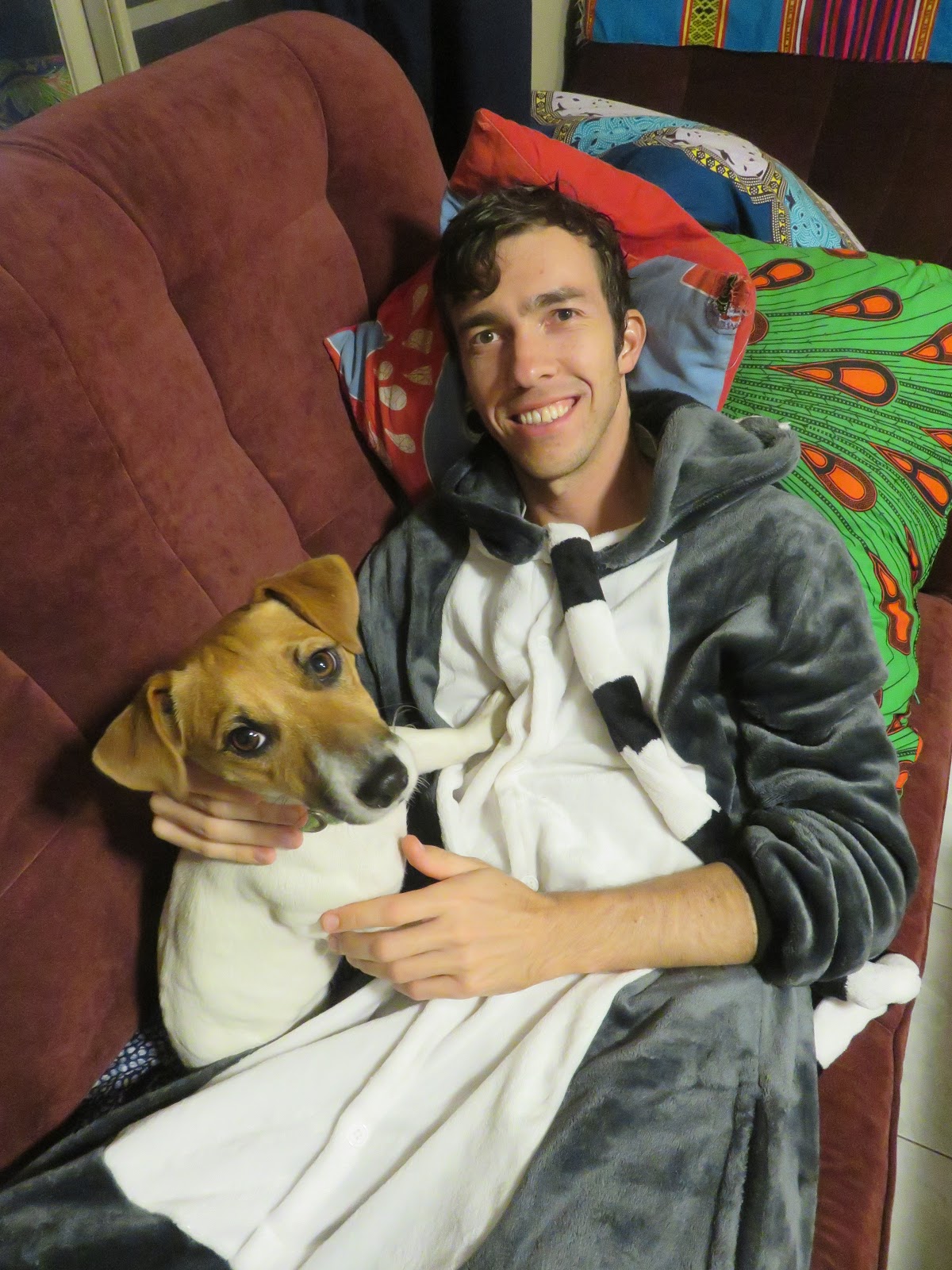
Feeling much better - yes, I'm wearing a lemur onesie

Love you all,

Matt

Update – I went back to work on Wednesday. Some of the symptoms (dehydration, headache) were still there but I was able to handle the day comfortably enough.

Wednesday, 1 May 2019

Malawi – The Foot of the Magical Mountain

April 18-20

Hello everyone!

Malawi is quite a small country and I’ve travelled around most of its highlights. One yet to be seen, however, is its highest.

The Mulanje Massif

Tea fields with Mount Mulanje in the background


Mount Mulanje is tucked away in the southeastern corner of the Warm Heart of Africa. ‘Tucked away’ is probably the wrong phrase; after all, it soars to 3,002 metres above sea level. Then again, its upper reaches are indeed hidden behind fluffy white clouds.

Mulanje town is about an hour from Blantyre


The view of the Massif on the way to Mulanje town

We weren’t climbing to the peak of Sapitwa on this trip. That name is apparently from ‘sapitidwa’ - ‘the place you cannot reach’. It is supposed to be quite difficult to get to the peak and its views aren’t said to be any more special than others you see as you scale Mulanje. In fact, we hardly climbed it at all, instead content to observe the soaring rock as part of a stunning background.

There are many 'peaks' to scale near the top

The southern side is dominated by tea plantations

Mulanje has many stories and legends. The most interesting to me is the idea that JRR Tolkien climbed the mountain and used its surroundings as inspiration for The Hobbit. Though people think he visited Malawi, the story is unsubstantiated.

The 'Shire' river is nearby!


Malawi would get a lot more tourists if they marketed this as Hobbiton

Below the big rock, much of this land is tea country - one of Malawi’s main exports, some of which will probably have ended up in the brew you’re drinking at the moment. Verdant green bushes stretch for miles, all neatly cropped to hip height. Though a breathtaking sight, one can only imagine what natural beauty lay here before it was razed for tea cultivation.


Tea pickers, with the canopy being their base

What you see in these fields as you walk along the terracotta tracks are off-white canopies, with hessian sacks bobbing up and down nearby. Those sacks belong to the tea pickers, who spend their days hand-picking the leaves come rain or shine. In this particular area, they get paid 1500 Malawian kwacha - $2 - a day.

Workers collect leaves and fill their sack


This man asked for a picture, then laughed when he saw it

This particular area is close to the Mozambican border, away from the relative hustle and bustle of Mulanje town. Driving from the major city of Blantyre doesn’t take too long, and is a spectacular journey as the granite massif looms ever larger from your car. Judging from some of the driving we saw, it may be quite the distraction, though I think the swerving of many saloon cars may have been down to what the drivers were drinking.

Cycling without a helmet on a 'motorway': suicidal

Cycling is the way many get around - this bike belongs to a tea
picker. Not sure how they'll remember where it is...

The incredible panorama is partly due to the sheer steepness of the mountain - many of the towns at its base are over 2 kilometres lower. It probably makes for some steep hiking - I’ve read that reaching the top is a 3 day return trip. Unless you do the Porters Race, a famous half-marathon up and down the mountain which happens every July. Friends who have done it have equated it to a marathon because of the sheer incline.

We walked the beginning of the 'Skyline Loop'

It's a long walk to the top

I imagine it is a place I would visit regularly if I lived in Blantyre. Coming from Lilongwe, it’s likely to be a six-hour journey each way. I am confident that I’ll be back to climb - though probably not run up - Mount Mulanje in the future. For now, I’m more than content to gaze up at the big rock from the vivid tea-studded landscape below.

Acacia trees are currently in bloom across Malawi


I hope I'll be back to do the big climb in the future!


Mulanje


Love you all,

Matt