Hello everyone!
Many of you reading this will be in a harsh, wintry lockdown. Masks on, keeping your distance - we all know the drill by now. Some places have been hit harder than others, with Malawi remarkably being one of those countries seemingly less affected by Covid-19. This was one of the reasons I decided to spend my December break having a ‘staycation’, rather than suffering through quarantines and swabs up noses.
 |
| Sunset at Likoma Island |
 |
| Crossing through international waters, yet still being in Malawi |
This is where it has taken me. Part of me feels obliged to apologise at this point. The last thing people who are trapped want to see pictures of sun-kissed beaches, dinners without spacing and visible, wide smiles in the open air. I’m not trying to rub it in! On the flipside, maybe it will make you realise there is some hope and that your travelling dreams may yet come true in the near future. Particularly if you visit the Warm Heart of Africa.
 |
| Southern hemisphere: warmer Decembers |
 |
| Our merry travelling band |
These pictures are actually from a part of Malawi which I’ve never been to before: an exclave called Likoma Island. Surrounded by Mozambican waters within Lake Malawi, it has long been on the hit list for many expats to visit.
 |
| Likoma is only about 5 km from the Mozambican coast, yet it still part of Malawi. I'll explain why in the next blog. |
If you’re loaded, or wanting to propose, you might fly from Lilongwe. If you’re like me and seven other teachers, you need an alternative. One that takes quite a long time and multiple forms of transport…
 |
| Part 1: my car (called Mavuto, the local word for 'trouble') |
 |
| Part 2: matola (minibus which can squeeze a lot of people into it) |
 |
| Part 3: ferry (the Ilala) |
After dropping the dogs off at their ‘spa’ (someone’s house - the two owners are kind/crazy enough to look after many people’s dogs whilst the owners travel), I slogged my 22-year-old Toyota RAV-4 six hours north to Nkhata Bay. I also dropped off a bed and lots of baby stuff to a crisis nursery for a friend. One of the police officers who pulled me over en route questioned me about the bed, as my car can hardly be classed as a vehicle fit for ‘moving cargo.’ I explained. He didn’t seem to get it. ‘Charity,’ I say, ‘Good thing.’ No fine, on I go.
 |
| Cots, prams and nappies were some of the donations passed on to the Mzuzu Crisis Nursery |
Nkhata Bay is a lovely spot which I’ve visited before. I’ll spend more time here after Likoma. What was important was that the car was here waiting for me. It was thus left under a tree at a friend’s unopen backpacker campsite. What could possibly go wrong…
 |
| A 7am rainbow after an early morning downpour |
 |
| Kayaking in the serene and croc-free water |
 |
| Mavuto is at the end, under a tree and next to a water tank |
Our group of twelve (6 teachers, 2 teenage boys, a few more extras to help us not talk about school) soon assembled and put our plan into action. Use the map below to help you if you’re not au fait with Malawian geography.
 |
| Step 1: Lilongwe - Nkhata Bay Step 2: Nkhata Bay - Nkhotakota Step 3: Nkhotakota - Likoma Step 4: Likoma - Nkhata Bay |
We had all driven to Nkhata Bay. We were then leaving our cars there and getting to Nkhotakota, from which we would get the weekly ferry across to Likoma. After a week, the same ferry would collect us and take us to Nkhata Bay, where we could collect our cars and plot our next move in northern Malawi. Simple!
 |
| A map on the Ilala showing its most important destination |
A couple of caveats. The obvious one you may have spotted on the map before is that Nkhata Bay and Nkhotakota are far away from one another. As we were sans cars, we needed a way of getting 12 of us with luggage to the more southerly port. This was what we got…
 |
| A tight squeeze |
The road wasn’t too bad for the first half of the rather cramped journey (which simply wouldn’t work if they implemented proper Covid protocols). It then got rather bumpy. Not too fun when you’re essentially sitting on metal.
 |
| This picture is misleading - there was a person in that gap! |
 |
| This is more accurate :-) |
Soon we were at Nkhotakota, staying in a bizarre hotel which had mechanical car parts as a key element of its decor. The owner proudly stated how a Malawian had designed this hotel to maximise air flow. Clearly that air flow didn’t make it into the rooms, leading to a sweaty, mosquito-laden night.
 |
| Sitima Inn: future setting for a horror story |
Luckily the night was rather short. We were awoken at 1:50am (don’t worry, we knew this was happening). The boat had docked and we needed to board before it left an hour or two later. There’s an estimated leaving time but...you know...TIA…
 |
| Funnily enough, not much can be seen at 2am... |
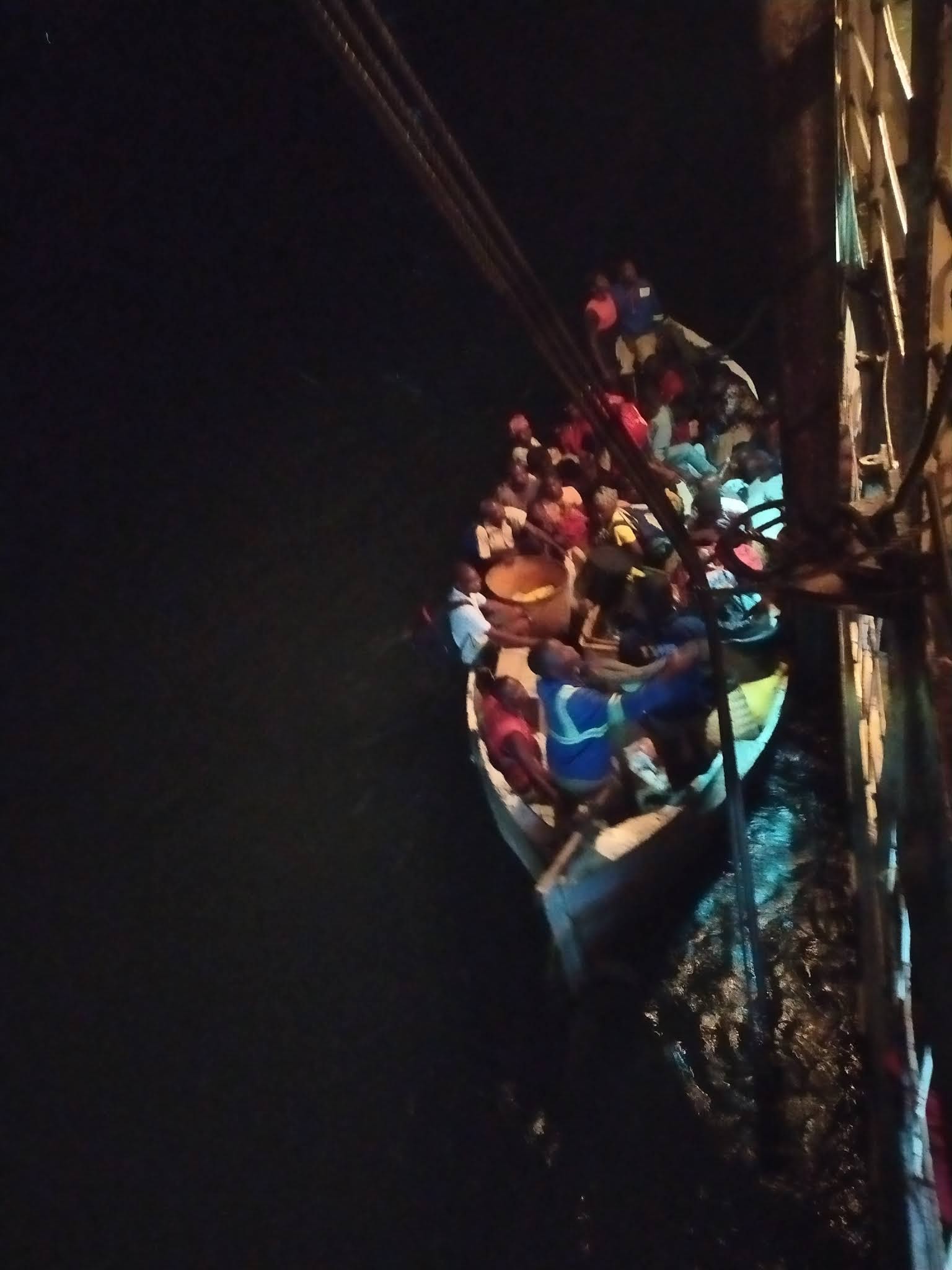
Also when I say ‘docked’, you may need me to paint a slightly different picture. Nkhotakota doesn’t actually have a jetty worthy of the name. To get to big boat, you therefore have to wade through the lake to a small boat, which then drives you to the big boat. At this point, you climb up from the small boat, hope someone else is strong enough to grab your surprisingly heavy case (thank you, Jack Daniels), avoid stepping on the large bowls of tomatoes, and finally fight your way through the crowd to get up top. Note to future self: don't take a suitcase, take a backpack.
 |
| On little boat going to big boat - photo taken with possibly the world's brightest flash |
 |
| Dozens of boats ferry people across to the...ferry |
This boat is called the Ilala and is famous throughout the land. It has been running up and down the shore of Lake Malawi since 1957, taking about a week to get up and back from its base in Monkey Bay. Even if I had the excess money to splurge on a flight from Lilongwe to Likoma, I would still probably pick the romantic option of the ferry.
 |
| The illuminated Ilala, 'docked' a few hundred metres from the shore |
 |
| What it looks like during daylight |
Admittedly, this romanticism was weakened at the sight of a live cow being attempted to be hauled onto the Ilala. The four goats, tied up by the ankles and bleating desperately, didn’t help either. This isn’t just a passenger boat - this is how goods (and cows, it seems) are transported across to Likoma and its smaller sibling, Chizumulu.
 |
| One of many goats - we assumed there was an animal section otherwise the chaos would have been magnified |
We were witnessing this chaos from higher up on the boat as we had paid for cabin rooms. First class, in effect. $10. It’s quite disheartening to thus see so many people crammed onto the lower level.
 |
| You may spot some goods in the boat as well as dozens of people |
Owing to a lack of sleep and three beers, I didn’t hear the boat leave. I awoke at around 8am and explored the ship. Likoma soon came into view, looking a bit less alluring than the lush, green Mozambican shore.
 |
| The south of Likoma Island |
Sometime around 11am, we docked at Likoma. Again, I say docked…Dropping our luggage to the small boat below seemed a bit risky, but nothing compared to some of the other, rather overloaded boats...
 |
| Look how low the boat is in the water! I imagine many of these people can't swim either... |
 |
| My rather heavy case being hoisted down |
I’d been told that there were 5 cars on the island. Five. One of which is an ambulance. Our lodge had organised transport in the form of a small pick-up, into which we all clambered. A few kilometres of bouncing over rocks (I can’t call it a road), which reminded me of the soreness of my bum from the previous day’s minibus journey, took us to our lodge.
 |
| I'm smiling because we hadn't started bouncing along at this point |
From Lilongwe to Likoma took me over 50 hours. The fact that the ferry only really goes once a week is a key reason why we haven’t had time to visit before. After a fun and thrilling adventure, I’ve made it to Likoma. Will it be worth it? Even if it isn’t, I’ll remember that so many millions won’t have this opportunity over the holidays, so won’t be complaining.
 |
| 3am never looked so good? |
 |
| An eight-hour boat ride - thankfully not in that one... |
 |
| Now we've made it, let the Likoma adventure begin! |
Love you all,
Matt


