Wednesday, 12 January 2022

Botswana - Where (most of) The Wild Things Are

December 26-28


I mentioned in my first Botswana post that it isn’t a country of great renown (well, until it was connected with Omicron). What you may associate it with, however, is being the focal point of many wildlife documentaries. Time to channel my inner Attenborough!


Lions are known as the only cats that live in groups

An elephant's pregnancy lasts 22 months

The geography can be a little bit confusing so bear with me here. I have moved from the western side of the Okavango Delta, where I spent Christmas learning to be a mokoro driver, and gone over to the eastern side. This involved leaving the Delta, driving around the southern edge of it and overnighting near the town of Maun, before heading north and entering the eastern section. You can go straight across…but not in a Land Cruiser…


Moremi is on the eastern side of the Delta

Beautiful reflection in the water

We had two of these: one for people, one for supplies

Being quite large, the west and east of the Okavango Delta are quite different. Goodbye water lilies and papyrus plants, hello this…

The area became a World Heritage Site in 2016

Sunrise and sunset are spectacular

Welcome to Moremi Game Reserve. Unless you have squillions of dollars at your disposal, camping is the order of the day here. We were actually wild camping. Build-your-own toilet and shower, that sort of thing.

Our home for two days

The shower was purposely weak as getting
water for it would be...tricky...

It meant we were far away from anyone else (not that it seemed as if there were many other people in the park anyway). Just us and nature. And boy, was nature nearby…

Some giraffes can stand half an hour after being born

Jackals have a top speed of 30 km/h

We were warned extensively about the dangers of leaving the tent at night. Hippos, lions, leopards…So when I desperately needed the toilet on the first night, I was filled with mild trepidation. This magnified when I shone my light through the mesh of my tent, as instructed, to see the shape of a hippo waddling along. I held it in. Unlike the monkeys who decided to have a screeching battle at 3:30am on the second night. Very inconsiderate.


Our fire was less for warmth, more for safety and cooking


Hippos are actually weak swimmers - they walk on the river bed


Moremi Game Reserve was established in 1963 by the wife of Chief Moremi of the Batawana people living in the area, because of concern about cattle encroachment and loss of wildlife. Before getting to the gate, there is a fence which separates domestic animals from their wild cousins. So no mingling between goats and elephants. Unless elephants break the fence, which they’re liable to do. In this ‘no man’s land’ between the fence and the gate, you actually see tons of animals. A free game drive if you live here!


Lilac-breasted rollers are carnivorous, hunting insects and lizards

Male elephants only reach full size after their 35th birthday 

Part of a journey of giraffe

Moremi covers 5000 sq km, one third of the Okavango Delta, and is home to some of the densest concentrations of wildlife in Africa. There were times when I questioned this, particularly on our marathon eight-hour game drive the first morning. Most drives are between three and four hours, and you would see more in those than we saw in the first six hours.


Every zebra pattern is unique


A baboon troop can have up to 300 members


But then we found these two, and harmony was restored to the Land Cruiser.


Lions spend a lot of time sleeping


A single leopard can have a territory
stretching dozens of square kilometres


Bird life is incredible in the Okavango, the Delta offering all a little flyer needs in life. I had zero interest in birds before moving to Africa; it’s hard to stay apathetic when you see the colour and hear the songs of birds such as the lilac-breasted roller and the carmine bee-eater. I think the Burchell's starling is now my favourite, its feathers changing colour in the sunlight like a two-tone convertible.


The starling also has a fun calling sound

The kori bustard is the largest bird which can fly

The southern carmine bee-eater moves across Africa during the year

A new animal here for me as well. Moremi has the biggest African population of red lechwe, an antelope which seems like an impala which has taken growth hormones and spent too long under the sunbed. No honey badger here, in spite of whispers that they may visit our campsite.


This is a tsessebe, a large antelope simiar to a topi

The red lechwe can reach speeds of 60 km/h
in wetland environments

The diversity of the habitats in Moremi often make you feel as if you have travelled to a different part of the world within the reserve’s space. From flood plains to dry savannah, there are a multitude of different backgrounds in which the animals can express themselves.


Scary even when still

Warthogs are vegetarians. Pumbaa,
from the Lion King, was not.

Getting from one area to another involves long drives on sandy tracks or through enormous puddles of water. We saw a white Chinese saloon car enter the park - I dread to think how that fared as it rolled through the puddles.


Quite often diversions around puddles had been established

Muddy tracks are more dangerous


My favourite area, and where I had my favourite Moremi moments, was the small lagoons which seemed to pop up indiscriminately. The hippo yawning session was hilarious (and slightly menacing considering they could end up visiting our camp), and the spotting of the greater flamingo was apparently so rare that it got our 64-year-old guide quite excited.


The 'yawn' doesn't necessarily mean tiredness -
it can also be a reminder of who owns territory

Hilariously, a group of hippos can be called a bloat 


Moremi Game Reserve is another lovely spot in Botswana. Certainly a place where Attenborough would be at home. At other times of the year, I would have hoped to see more animals such as rhino and cheetah. Whenever I start to get greedy about animal sightings, however, I have to pinch myself to remind me of how lucky I am to be here, and how lucky we are to have such incredible nature on our planet.


Keeping a very safe distance from the hippos!

Look how wide my smile is!

A magical Moremi sunset


Love you all,


Matt

Tuesday, 11 January 2022

Botswana - Matt becomes Mr Mokoro Man

December 23-25


Hello everyone!


One of Africa’s iconic landscapes is the Okavango Delta, found in northern Botswana. A place of stillness and silence - unless you put me in charge of the boat…


Sitting in, not steering, a mokoro -
more comfortable for everybody 

Sunrise in the Delta


Normally, water that flows through a delta ends up in the sea. Think the Nile Delta in Egypt as an example. All of the water which reaches the Okavango, however, never reaches the sea again. Owing to the flat nature of the land (I read that its altitude doesn’t vary by more than two metres), it simply runs out of energy. Either the water is drunk by plants, or it simply evaporates or transpires into the sky. 


Approximately 11 cubic kilometres of water flows
into the Delta each year. That sounds like a lot...

The area of the delta is…massive. It’s area can cover up to 18,000 square kilometres. I’ll be visiting the delta a couple of times, as there are different focuses in different parts of the wilderness. My first stop was on the west, just below an area known as the Okavango Panhandle.


At its largest, it has almost the same area as Israel


The quality of the roads in Botswana had impressed me up to this point Specifically, up to the town of Gumare. After that it seems that this particular road is a no-go zone for the road authority. A 50km drive ‘on road’ took 2 hours. We did see some wildlife on the way, at least.


Ostrich crossing!


After that we transferred equipment onto a 4x4 truck which drove us, through driving rain, to the Guma Lagoon. Worth it when you see the water for the first time…


A positive effect of the rain

The lagoon looked like glass as daylight faded


I spent quite a lot of time at this viewpoint, waking up each morning for sunrise and seeing a technicolour transformation of the landscape as the sun set on the unseen side.


Sunrise was generally at about 5:45am

Stunning serenity - a great way to start each day


Of course, the Okavango Delta is so much more than a small lake. The easiest way to explore is using a motor boat. This allows you to snake through the papyrus-lined waterways and venture further into the wilderness. You can get up close and personal with some wildlife as well, though I wasn’t too keen on being about a metre away from a crocodile…


A croc's gender is determined by the temperature
at which its egg was incubated


One issue with using a motor boat is the noise it generates. The obvious downside is that it scares away many of the bright, beautiful birds which call the delta their home. 


A fish eagle is the national bird of four African
countries...but Bostwana is not one of them

The African jacana has long, slim toes to help them 'walk on water'


There are other, quieter methods of transport. WIth the delta’s water level being a bit lower at this time of year, you can walk around on some of the islands which get created by the waterways. These have steadily been developed over millennia by millions of tonnes of sand being carried down the Okavango River from Angola. It’s slightly surreal to think when walking that you would be underwater in that very spot later in the year.


This land is underwater in June, apparently

Many islands are actually too salty to support plants


Shallower water also means that you are more likely to see one of my favourite animals: the humble hippo. We spotted a raft of them on our walk and got reasonably close, albeit with a very restricted view. The fact that most of the people in my group had never seen a hippo before made it a pretty exciting experience.


It's called 'kubu' by the Tswana, meaning 'rebellion'


The main method humans have used to enter the depths of the delta, however, has been using a mokoro. This is essentially a canoe which has been fashioned out of the trunk of a tree. Government restrictions to protect the environment mean that modern mokoros are made of fibreglass but they still work in the same way.


Very similar to punting

Water lilies were ubiquitous in areas with more water


A mokoro is narrow enough to penetrate the ever-thinner waterways as you move towards the heart of the delta. They aren’t particularly comfortable (my legs went numb after about ten minutes) and can only fit two passengers plus a driver. They also can be tricky to steer (more on that later). But a mokoro ride is…just…lovely…


A mini-lagoon in the Delta


There is a stillness and an aura of calm which comes over you as the boat silently glides through the shimmering water. The only noises are the harmonies of various bird calls or the rustle of the overhanging papyrus plants with the breeze. This is an experience to have if you need to switch off from life.


The grass grows well over a metre tall


I’ve mentioned birds a couple of times. All colours and sizes, there are apparently over 450 different species! Personal favourites we spotted include the malachite kingfisher and red breasted barbet. Their calls and hoots added to the atmosphere as we filed slowly through the watery channels.
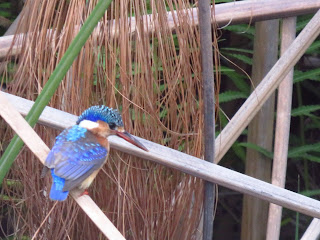

Malachite is a green mineral but they are not green

It took me ages to spot the barbet

They probably had a right hoot when watching some of us attempt to control the mokoros. My balance isn’t fantastic. Trying to keep a long, narrow canoe upright whilst standing up was initially a bit intimidating. Pointing your left foot forward and your right foot 90 degrees clockwise behind you, the driver uses their long pole to push along the sandy bed of the waterway.


Mokoro man!


Great fun. Needless to say, we weren’t allowed to drive them back to base. Instead we got to once again take in the tranquility.


Boats are also used by locals as a way
of moving around the swamp


Gliding around in a mokoro in the Okavango Delta demonstrates its serene, tranquil side. I’m looking forward to seeing larger wildlife on the other side of this fascinating landscape. Either way, a lovely place in which to spend Christmas.


Christmas brunch - after my Christmas
pudding/custard breakfast


'Pula' is cheers! It also means rain...

Love you all,


Matt