December 29-30
Hello everyone!
I have lived in Africa for five-and-a-half years now and have seen some otherworldly, incredible things. What I hadn’t seen before coming to Botswana, arguably the only animal of interest that I hadn’t laid eyes on, was the not-so-humble honey badger. Until now.
 |
| Honey badger in Savuti |
 |
| Botswana has the biggest elephant population on the planet |
The magnitude of this needs a bit of context. Hannah and I were introduced to the honey badger shortly after arriving in Malawi in 2016. Having learnt about it, specifically through this video, we decided with our friends that this was our animal. It represented our attitude (some more than others). We named our volleyball team Honey Badgers and would always ask about finding one on each and every safari trip. Usually, guides…would…laugh.
 |
| How guides would react when we said we wanted to find a honey badger |
Generally nocturnal and notoriously hard to find, the honey badger had eluded both of us. Even Hannah’s parents had seen one in Namibia. Hannah, staying in a different tent, hadn’t. The hunt has been on for a long time, and the latest attempt had taken me to Botswana.
 |
| A leopard tortoise, a member of the 'Little Five', is much easier to find than a honey badger |
 |
| In theory, honey badgers can be found in all of sub-Saharan Africa! |
Slight caveat at this point - I had seen honey badgers hours after entering Botswana. As dusk turned to dark, two of the critters zipped across the road in front of our bus as it drove up the highway. I had seen them, but not properly. Until getting to Savuti.
 |
| The road which I saw two honey badgers cross |
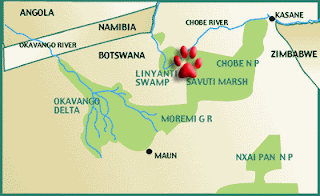 |
| Savuti is on the western edge of Chobe National Park |
Savuti is actually part of the more well-known Chobe National Park, situated in its southwestern corner. Getting there involved driving through the northern section of Moremi Game Reserve, then on a rather bumpy stretch of sandy tracks for what seemed like an eternity. This often gets laughed off by guides as an ‘African massage’; you need an actual massage after having to deal with those roads for 4 days.
 |
| Some fared better than others. This car was still there, abandoned, when we left two days later. |
 |
| Sunrise in Savuti. Note the depth of the tyre tracks! |
We were wild camping again. No hippos do deal with this time, though this group had a den quite close to our campsite…
 |
| Our camping spot |
 |
| They can be called a 'cackle' of hyenas |
A lot of Savuti is flat marshland, allowing you to see far and wide across the landscape.
 |
| An ostrich strolling along the marsh |
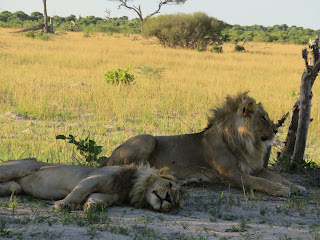 |
| Other areas, like where these lions were, are drier |
The channel which gave the area its water is very inconsistent. It stops flowing for long stretches of time, drying up the land. It bizarrely started flowing again in 2008 for two years, completely changing the scenery. At the moment it isn’t flowing, resulting in a drier area which needs some of its watering holes to be articifially filled to ensure there’s enough water for the animals. The water the elephant is using in the video below is one such example.
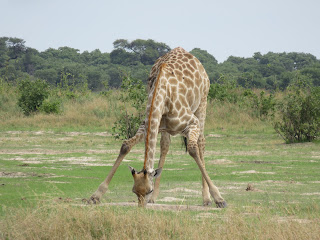 |
| Giraffes do a mini split with their legs to be able to drink |
Of course, this is less of an issue in this current wet season. More pertinent as a problem is the possibility of getting stuck in the mud. Our Land Cruiser almost met a muddy demise after it slipped into the pre-existing tracks, which were very deep and sludgy. Somehow Johnson engineered an escape, though I don’t think the engine appreciated being revved that high.
 |
| The stunning southern carmine bee-eater in flight mode |
As there are more places for drinking water, some animals once again proved elusive. The rhino and cheetah that we were told are in the area weren’t seen. Once again there were some arduous drives which sapped the energy out of us all.
 |
| Two banded mongoose |
 |
| Impala sucking nutrients from a termite mound |
On one such morning drive, having been travelling around for almost four hours and having only really seen a running hyena and a giraffe, I was falling in and out of sleep at the front of the car. The others were in the higher seats at the back. One of the men suddenly shouted for the car to halt. Johnson and I had no idea why. The man then said the immortal words. “There, on the right. Is that a honey badger?”
 |
| On first glance...no... |
It was like a jolt of electricity had been injected into my body. Fully alert, eyes darting across the verdant grass, we could see something moving. Suddenly, a head appeared…
 |
| ...then a shape started moving... |
Mission. Accomplished.
 |
| Honey badgers look a bit like skunks...and apparently have their capability of stinky smells as well... |
For me, Savuti will always have a special place in my mind for being the location of the honey badger. We had some other highlights as well, particularly on our final afternoon drive. This was a proper drive, full of the thrill of the chase and with some up-close encounters.
 |
| Stormy clouds at sunrise - they exploded later |
It started with a massive thunderstorm - we had to hide in our tents. When the rain relented, we headed out into an atmosphere that just felt different. I can’t put my finger on why. It seemed as if animals had been driven from their havens, into the open.
 |
| A leopard devouring an impala |
That leopard was the first thing we saw. Almost identical to what I saw in South Luangwa, Zambia, two months ago. The crunching sound of the big cat grinding any flesh off the bone seemed to reverberate.
 |
| Our guide thought the leopard had caught the impala a day or two before |
Another car pulled up, loving what we had found. The driver then told us he had been trailing wild dogs about a kilometre from our location. These, to the unaware, are some of the rarest animals you can see on safari. I’ve seen them once. I’ve actually now seen a honey badger on more occasions. Chobe has one of the world’s largest remaining wild dog populations. We left the leopard to its lunch and followed the directions.
 |
| After its meal, the leopard took a siesta on a different branch |
We found the spot, followed the tracks they had left on the floor, looked in vain across the marsh…they’d gone. Wild dogs are a fast-moving, wide-hunting pack machine.
 |
| Wild dogs can run as fast as a greyhound |
Whilst on the lookout, we found a small herd of elephants, complete with a young baby who we were told was about 3 months old. It seemed as if his two siblings were acting as his bodyguard as they stood in the road. Then they started to move closer…
Why I put the window up, I have no idea. What protection would that give from an elephant?? I took a bit of stick for that! The baby got to satisfy its curiosity about the car, we got to move on safely. Success all round.
 |
| A mildly irritated elephant |
 |
| This was another herd we found minutes later |
Savuti was a success. Though in my mind, it couldn’t have been a failure as soon as we saw the honey badger…
 |
| Dreaming of impala... |
 |
| A majestic lion |
 |
| A fitting end to a colourful adventure in Savuti |
Love you all,
Matt


