Tuesday, 11 August 2015

Bosnia and Hercegovina – Gunshots heard around the world

8-9 August

Hello everyone!

From Mostar I took a train – incredibly, my first on this trip and one with some stunning scenery – north to the capital of Bosnia and Hercegovina: Sarajevo. It has been the location of much bloodshed over the centuries and has been the trigger for two major wars in the twentieth century.

 
View from the Mostar to Sarajevo train


View from the Mostar to Sarajevo train


The old town of Sarajevo sits on the northern side of the Neretva River. It was from this side of the Latin Bridge that crosses this river that a young man called Gavrilo Princip pulled the trigger of a pistol on June 28th, 1914. The shot killed Archduke Franz Ferdinand and led the Austro-Hungarian Empire to declare war on Serbia. Various alliances and agreements led to most European powers being dragged into a battle which lasted four years and killed millions. The First World War.

 
An artistic interpretation of events on June 28th, 1914

The Latin Bridge, where the assassination took place

The spot where Princip took aim is marked by a plaque and the events of that day are commemorated in other ways as well, such as the naming of hostels.

The plaque marking Princip's assassination spot


It is sobering to think that the war was happening one hundred years ago, with all of the damage and suffering it caused. Sarajevo, tragically, has had to endure more recent misery and fighting.

A charred Holiday Inn during the siege of Sarajevo


One of the dozens of grave sites dotted around Sarajevo
  
Sarajevo, which is situated in a valley, was surrounded by Serbian forces in early May 1992 after it stated a desire to become independent. Bombing and shelling from up high decimated the city. Phone lines were destroyed. Water, gas and electricity supplies were cut. Food stocks shrunk rapidly. The subsequent siege by the Serbian troops lasted for 1,395 days – almost four years, and the longest city siege in modern history. Buildings were battered and torched, including most of the works in the National Library.

The National Library, Sarajevo


In Sarajevo alone, 10,615 people were killed. 1,601 children. Many more were invalidated or gruesomely injured. In our vastly-expanding global population, Sarajevo’s population has shrunk significantly since the last census in the late 1980s. This all happened less than 25 years ago. In my lifetime, and probably yours too.

A monument depicting a man shouting to his child that everything would be OK as Serbian troops advanced in Srebenrica, eastern Bosnia. Their bodies were found over a decade later.

The overwhelming majority of dates on the tombstones are between 1992 and 1995

The eyes of the world were on Sarajevo during the early 1990s, as they also were ten years previously when the city hosted the Winter Olympics. If you’re British, think Torvill and Dean. That happened here.


This sign was in the Marriott Hotel in Sarajevo. Next to the Dean room, naturally...
  
As with many cities that host these extravaganzas, many of the venues in Sarajevo have fallen into a state of non-use and sorry disrepair. I hiked up a steep hill to visit the bobsled track. Clearly it wasn’t going to be in use when temperatures were positive rather than negative 30 but it was obvious to me that it isn’t used in the winter either. I took time to walk down some of the track, which is laced with interesting graffiti on all of its curved banks.

The final bend of the bobsled track


If they’re no longer into their four-man bobsled, the locals are certainly up for football. A group of us went to watch the local team and champions, FK Sarajevo, take on another team in a league game. I was struck by the shirt sponsor on the replica shirts – Visit Malaysia. Something twigged in my brain and suddenly I remembered why they would have this sponsor. Their owner is a Malaysian businessman called Vincent Tan…who also owns my local team, Cardiff City. Interestingly, he hasn’t changed the shirt colours here. Yet…

Tan (centre) owns Cardiff City FC as well as FK Sarajevo


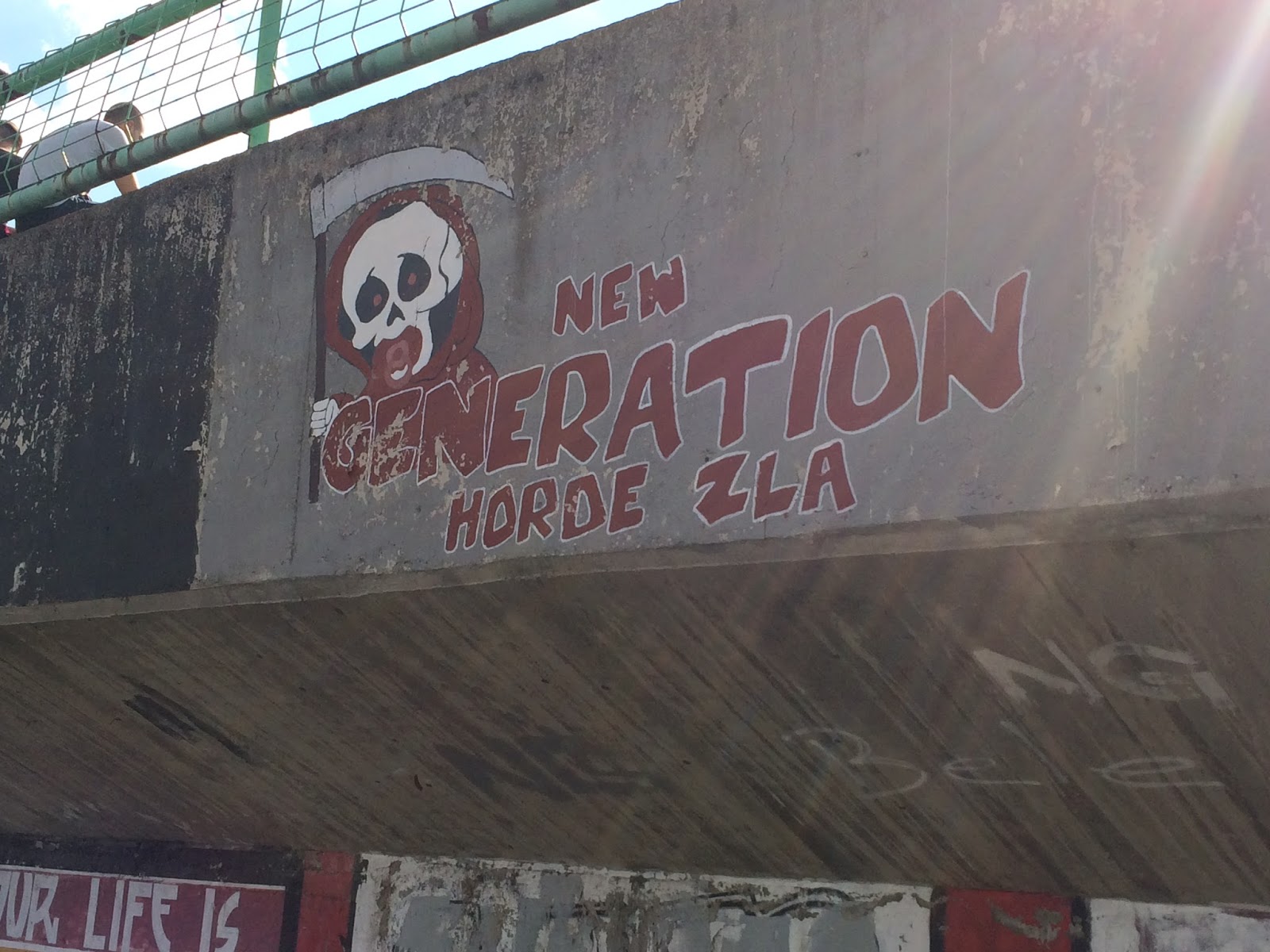
The large bowl of a stadium had a vociferous singing section (in Britain we might think of them as hooligans) behind one of the goals. Their chanting was choreographed by topless men at the front and was as relentless as it was impressive. They didn’t even stop to realise that the opposing team, Široki Brijeg, had scored the opening goal. Flares were also ignited to ensure that stereotype I have of eastern European football fans was maintained.

The hardcore fans of FK Sarajevo


Smoke billowing towards the pitch after a flare was ignited


Frustrations boiled over even after an early second half equaliser was tucked away. One man slammed his sunglasses into the floor, picked them up and then slammed them down again to make sure they were broken. It wasn’t until a delightful chipped winner from the number 11 that the nerves dissipated. If they ever need a reality check as they bemoan a bad touch or misplaced pass, FK Sarajevo supporters can look just over the far stand and see the bright white plinths of a grave hurriedly formed during the recent war. It’s only a game.

Security guards had to protect the referee when he blew for half-time after he made a debatable decision against the home side


The best player on the team is brilliantly called Harmony, which is a word I’d use to summarise the atmosphere in Sarajevo. Religions live side by side, with large churches (both Catholic and Orthodox) in close proximity to the old synagogue and dominant mosque in the old town.

The minaret of the mosque with the Clock Tower (with Hebrew numbers) just behind

The beautiful fountain in the grounds of the old mosque
  
Of course people don’t want to forget the horrors of the Balkan Wars and there are plenty of painful reminders of the struggle that Sarajevo went through. Now, however, there is a buzz and happy aura sifting through the narrow streets of the Muslim quarter (though that may be the shisha). The city is moving into the 21st century whilst retaining its Ottoman charm. I only one full day here, which simply wasn’t enough to appreciate its vast and significant history. Important events which shaped our current lives have happened here and they are commemorated well in Sarajevo.


View of Sarajevo from an area close to the bobsled track
  

Love you all


Matt

Saturday, 8 August 2015

Bosnia and Hercegovina – Wild waterfalls and wilder men falling in water

August 7-8

Hello everyone!

My time on the coast has ended for this particular trip. No more concrete beaches and monstrous cruise liners obscuring fine views. For the rest of my journey up to Prague I’ll be inland. That’s not to say that I’ll be away from water, however. Indeed, my first stop since the sea of Slano and Dubrovnik has been epitomised by the aqua blue.


Being honest, here in Bosnia and Hercegovina the colour of the rivers and lakes is more reminiscent of turquoise or pale emerald than of our stereotypical colour for the sea. The river I’m talking about bisects a town called Mostar, which is the largest settlement in the Hercegovina region.


The Neretva River in Mostar

The name of the country is Bosnia and Hercegovina. Often we shorten it to ‘Bosnia’ but this only represents the northern terrain of the country. The southern area is, and has for centuries been, Hercegovina. They were united as one country by that traditional medieval method…of marriage. We were told about this on a tour of the region in the lovely village of Blagaj, where an old monastery creeps over the smaller cliff with a cool, flowing spring below.

The spring at Blagaj


The monastery was built in the 16th Century at the request of an Ottoman sultan

From here we briefly visited one of the Catholic Church’s more intriguing pilgrimage sites: Medjugorje. In 1981 six teenagers, on a long hike from the village, claimed to have seen an apparition from the Virgin Mary. They have since stated that they are now regularly visited by her. As a result, scores of Catholics visit Medjugorje in the hope of being visited themselves. This is in spite of the fact that the Vatican doesn’t recognise this as a pilgrimage site and has grave doubts about its authenticity.

Over 15 million people have visited the village since 1981


Many pilgrims are from Catholic-dominated countries such as Italy and Ireland

We spent most of our time during the day tour of Hercegovina at the Kravica waterfalls: a stunning set of gushing water chutes. From up high it actually reminded me of a theme park, minus the slides and screaming children of course. The land curves around, creating a cove at the bottom to swim in. Cold would be an apt description of the water.


The highest waterfall is 25m

Clambering over the rocks and dipping heads under the torrent of water crashing down was a tremendous experience. It also helped us cool off as this region gets rather warm; we were told that Mostar was the hottest city in Europe on average through July, with temperatures regularly rocketing over 40’C.


The waterfalls at Kravica

After a few hours frolicking in the falls, our final stop was the village of Pocitelj. Ominous thunderclouds were beginning to form over the surrounding hills as we arrived, which added to the sombre atmosphere of the place. This, along with many sites in Hercegovina, was one of the large battlegrounds during the Balkan conflicts of the 1990s. Muslims were being bombarded from Serbs on one side and Croats on the other. Most people have left the old stone village, which was severely damaged.

The end of the fortress at Pocitelj


The architecture is in the Ottoman style, reflecting the time of its development

Going on a tour such as this introduces you to some of the more local aspects of life which may be neglected in larger cities. Though all of the places we visited cater to tourists, there still seems to be a more sedate pace and value of heritage. This extends in particular to food and drink. In Blagaj we were treated to enormous breakfast bureks along with traditional Bosnian coffee (same as Turkish coffee with that weird residue left at the end of your cup), whilst in Kravica we got to sample some local rakija, which is the spirit de jour of the Balkans. Lots of rakija, in fact.

The old-fashioned way of cooking a burek pie

Rakija comes in a variety of different flavours, walnut undoubtedly being the worst!

A sensible person would need a lot of rakija in order to experience the main event in Mostar. In many Slavic languages, ‘most’ means bridge. Mostar is thus named after its beautiful old bridge…which people naturally jump off into the aforementioned greenish river below.

The old bridge by night

Crowds gather on and below the bridge to watch the divers

Not just a little below. 24 metres below. Members of the local diving club are the ones who rise (and fall) to the challenge of landing in the river without shattering every bone in their body. Tourists are allowed to have a go if they prove themselves during a training course. A month ago someone who was staying in my hostel had a go, landed almost perfectly…and broke two vertebrae. It is not for the faint-hearted. Or any normal person.

The view the diver will have of his landing zone


The divers spend time collecting money for their bravery


But what fun to watch! The divers clearly know this as well and make a great spectacle of it, walking precariously along the edge of the bridge collecting money, swooping arms up and down like a billowing swan before taking a deep breath and launching themselves to the depths below.


Mostar itself is a nice place, though scars of the war are clearly still visible. The bridge itself was destroyed in 1993 and only reopened 11 years later. You can walk on the front line, which is a road one block west of the river, and see the battered buildings. Graves take up any available green space. Seeing the age of many of the buried makes one’s heart sink.

An abandoned building on the Boulevard road in Mostar

The marks in the wall of this house are bullet holes


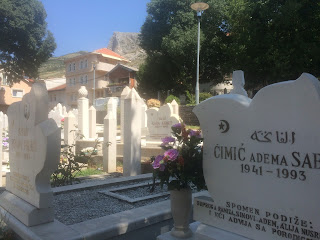
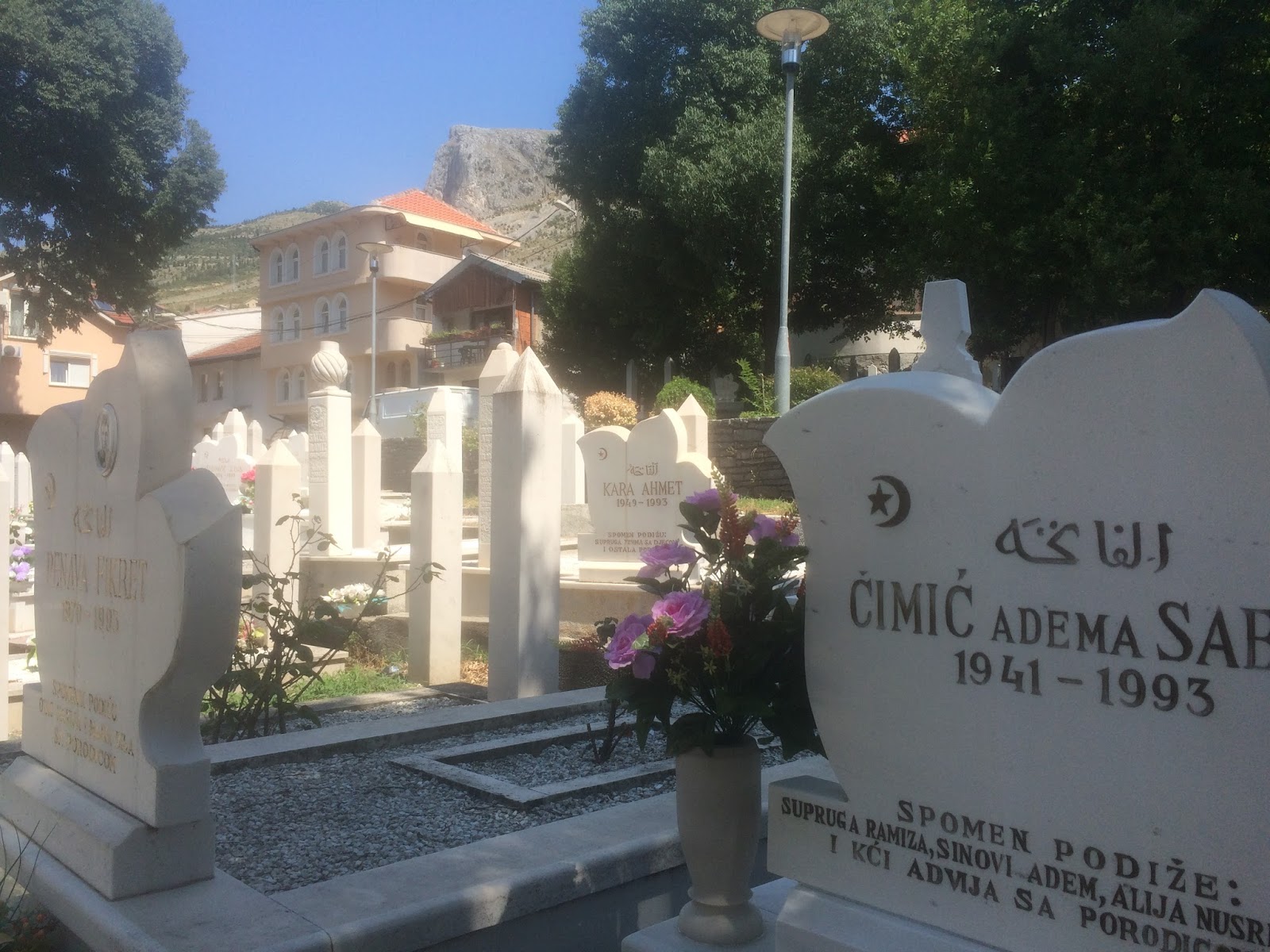
Graves were created on any available space in Mostar

Whilst remembering and acknowledging the past, Mostar would seem to have a bright future. The tiny old town, all centred around the bridge, is throbbing with people. It is the main town of a delightful and, to me, surprisingly beautiful part of the Balkans. Hot, hot Hercegovina has been a pleasure to travel through.


Love you all


Matt