Wednesday, 28 October 2015

Turkey – A fierce, flare-waving football rivalry

October 25

Hello everyone!

Sport is tribal by nature. One will always support their tribe, yet when pitted against a rival, be it a political, historical, geographical or trivial one, that person will cheer a little bit more vociferously than normal. Anyone who has been with me when Wales have beaten England in the rugby – which has happened quite a few times lately – will be aware of this. The event, the sporting spectacle, becomes much more intense when there is a tribal rivalry attached to it.

 
Galatasaray fans: notorious for their passion


Fenerbahçe scarves on sale before their derby against Galatasaray


I’ve been lucky to witness quite a few sporting rivalries in my life thus far. From a Severnside derby between Cardiff and Bristol City which was tame due to the kick-off time (Sunday lunchtime) and the gulf in quality between the teams (Cardiff won 3-0) to a hostile and extremely loud ice hockey arena where Slavia and Sparta Prague punched holes into each other, I’ve seen many sporting matches between two sides which openly despise one another.

City and United are the two main protagonists in the Manchester derby, which I've seen twice


Watching from the away section of a Slavia-Sparta ice hockey derby was a fascinating experience

There does seem to be a stereotypical difference for my generation in how exactly these rivalries are played out off the pitch. Mainly, the further east you go in Europe, the more violence there is between fans. Growing up supporting a team which had one of Britain’s most notorious hooligan groups, I’m aware that this is…codswallop. However, television footage often shows Eastern European football derbies, whether inter-nation or intra-nation, descending into chaotic violence due to the tribal vengeance spilling out of the segregated stands.

Fans in Greece are stereotyped as being loud and loving flares

An image from the Bosnian football match I watched earlier in the summer, when play was briefly delayed to allow the smoke to dissipate
  
Which brings me nicely onto the Kitalararasi Derbi: the Intercontinental Derby, played between Fenerbahce SK and Galatasaray SK. Istanbul's two football behemoths.

A newspaper on the day of the game


Europe vs. Asia
The rivalry between these two teams is legendary and bloody. It’s geographical: Europe (Gala) vs. Asia (Fener). It’s historical: their match in 1934 apparently resembled a warzone by the end, with all players fighting. It’s equal: these are Turkey’s two most successful teams and both have won the league title in the past few seasons. It’s not passionate: to say that these fans are passionate is like saying Siberia is a little bit chilly in winter. They’re nuts. You’re also recommended not to wear certain colours in certain areas of the city. They take their teams very seriously over here.

Gala and Fener are the two most popular teams in Turkey


Tempers often fray both on and off the pitch
Tempers once flared when the manager of Galatasaray (a Scotsman) planted their club flag in the middle of a pitch. Fenerbahce's pitch. He caused a riot. 

Graham Souness inciting the hatred of millions with one idiotic action

Luckily for us, this derby of great magnitude was happening in Istanbul when we…were in Istanbul. Ticket prices were extortionate (€300 was the going rate online) for the match, to be hosted by Fener on the Asian side of the city. I’d never made it across to Asia on my previous visit to Istanbul in 2008, so we combined this new experience with sampling a bit of the pre-match atmosphere.

Of course, this could also mean 6pm as the times were still not synchronised at this point


Fans in Kadikoy on the Asian side of Istanbul: Fenerbahçe's patch


The scenic way to get to the Asian side is to take a ferry from the port of Eminönü in the old city. Whilst queueing to board, we realised that we were in the company of numerous Fener fans. One had a drum which he banged until dropping his sticks. Which happened fairly regularly.


Aboard the ferry with the noisy Fener fans
  
On board we sat outside to witness the spectacular views of Istanbul from the Bosphorus, as well as listen to some of the chanting. We were allowed two minutes of this before this happened…


Safety first! It gets quite difficult to breathe when your lungs are being filled up with smoke from flares, in addition to dodging the sparks whizzing off them at random directions.

We followed the swarm of Fener fans briefly upon disembarking at the port of Kadiköy before heading into the markets to get a feel for Asian Istanbul. The feel we currently had was marvellously loud and mad. All of this was over five hours before the game was due to start.


Fans continued to chant wildly as they left the ferry and headed towards the stadium
  
Preferring to return to Europe in daylight, we left the Asian side with a plan to watch the match when it kicked off in the evening. Owing to the religious tendencies of the majority of locals, bars are in short supply. It is therefore nargile – shisha cafes – which display the matches on giant screens. They were packed beyond capacity even before the game had started. 

The cafe we were recommended for the match was full before the game had started
  
On a whim, we headed for the modern centre of Istanbul: Taksim Square. Prior knowledge (also known as looking at a map before visiting) had suggested two reasons why the game might be shown there. Firstly, it is where most of the city’s nightlife of bars and clubs are located. Just as importantly, however, it is situated in the district called Galata. I’ll let you put two and two together there.

 
Taksim is in the Galata district of Istanbul: GALATAsary claim this as their home


The streets near Taksim Square were dominated by the yellow-and-burgundy colours of their local team
  
Sure enough, we found a shisha café in an alley just off the middle of Taksim’s busiest street just as the half-time whistle blew. Locals weren’t impressed: Fener were one goal ahead. I settled down to my mint and rose water pipe and watched as the game recommenced. Dozens of other people soon gathered behind us, resorting to standing as all of the seats were taken.

Where we watched the match, in a side street off Taksim's main thoroughfare
  
My lovely, relaxing, light-headed-inducing shisha pipe

Every misplaced pass was met with a howl of derision. Every ever-so-slightly contentious refereeing decision was greeted with what I’m assuming was abuse in Turkish. Then, with seven minutes left on the clock, Galatasary went and scored an equaliser in the stadium of their arch-rivals.


The game finished 1-1. From where we were sat, it seemed as if the Gala fans had just actually won the league. Particularly from the main street. We popped down to discover why there was so much noise.


These were on sale in Kadikoy, on the Asian side. It might explain why so few had been bought...
  
Turns out that the Galatasaray club shop was about 50 metres away from where we had been watching the game. The ‘leader’ of a group was on the balcony leading the fans in a variety of songs. I’m sure the lyrics were lovely.

Fans singing outside the club shop in Taksim


A little part of me would have loved to witness this intensity, this insanity in person. However, throughout the day we saw fans lighting flares, banging drums, screaming songs and hugging with joy when their team hadn’t even won. We observed enough to understand the rivalry between Galatasary and Fenerbahce. This was sporting rivalry at its bitterest…and I loved it.

A point apiece left both teams chasing Besiktas, Istanbul's third team, who top the table at present


Love you all


Matt

Tuesday, 27 October 2015

Turkey – The melting pot of Istanbul

October 24-26

Hello everyone!

The place where east meets west. The destination where two continents join. The end of one civilisation and the start of another. A mix of a myriad of cultures. Clichés abound about Turkey’s largest city: Istanbul. It’s also a place which very few people have a bad word to say about.


The Bosphorus, which divides Istanbul into three distinctive areas


It’s been a while since I was here. Seven years, in fact. In 2008, when I previously spent time in Istanbul, I had stitches removed from my head and was trying to live on scraps. My travelling methods have changed slightly since then; I was fascinated to see whether this metropolis had modified as well.

A man shaving a doner in 2008. When prices were much lower...

Walking through the Grand Bazaar in 2008. I have enough money to buy more than a bowl this time...

Of course, many of the main attractions of Istanbul were here when I last visited; indeed, they've been around for far longer than I have been on this earth. One of the oldest is the world-renowned Hagia Sophia, the current and third version of which was built in the sixth century.

Hagia Sophia

The beautiful interior of Hagia Sophia

This beautifully rustic building, with its fading red exterior and seemingly crumbling brickwork, was originally constructed as a church by an Emperor called Justinian. The reason I say it was a church is because of what happened here in 1453; an event which shook the Christian world at the time. The sacking of Constantinople.

Hagia Sophia from the front entrance

An artistic interpretation of the conquest of Constantinople, what Istanbul used to be called

The Ottoman conqueror, Sultan Mehmed II, converted the church into a mosque. It remained an active mosque until 1935, when it was changed into a museum by the founder of modern Turkey, Mustapha Kemal Ataturk.

An example of Islamic-styled decoration in Hagia Sophia

The interior of Hagia Sophia

What I found fascinating is how many Christian elements were maintained in the Hagia Sophia, even when it had been a mosque for hundreds of years. Mosaics depicted biblical events and people are still visible on the top floor, as are notes from one of the synods from the 12th century. It shows an acceptance and tolerance of other religions.

The symbol in the corner is a Christian symbol


Looking out of the southern-facing windows will explain to a visitor one of the main reasons why the Hagia Sophia is no longer active as a mosque. It doesn't need to be when one of the largest and most famous mosques in the world is across the street: the Blue Mosque.

The view of the Blue Mosque from Hagia Sophia
The Blue Mosque

This apparently is only one of two mosques in the world which has six or more minarets. The other one is in Mecca: the holiest of all Islamic sites. The Blue Mosque is therefore a big deal and has been since its construction was completed in 1616. As with all mosques, certain clothing has to be worn or removed prior to entering. Animals are also forbidden from entering, in spite of this dog’s best efforts.


The dog eventually tired of queueing

The idea of the mosque and its scale was to emphasise Islam’s superiority over Christianity and its size certainly screams dominance and power. Its central dome is 43 metres in height and almost 24 metres wide. The mosque itself is adorned with over 20,000 blue tiles, which is why the Mosque of Sultan Ahmet has a more common name.

Inside the Blue Mosque

The blue tint is very noticeable inside the mosque

At the last count, in 2013, there are 3113 active mosques in Istanbul. Another of the ‘heavyweight’ temples is the Süleymaniye Mosque in the old city district. This has breath-taking views of the Bosphorus River which dissects the city.

The Süleymaniye Mosque

A view of the northern, more modern side of European Istanbul from the mosque


These three attractions lead scores of people to Istanbul, even in October. I was surprised by the plethora of tourists who are visiting the city even when the temperature drops to single figures and the rain starts to fall. Interestingly, Istanbul receives more annual rainfall than London. No stigma attached here, though.

The line to enter the Basilica Cistern

Dark clouds hovered throughout our trip; luckily for us, it only rained once.

Millions of tourists visit but there are more than enough locals to make this metropolis seem like a swarming beehive. Approximately 15 million, in fact. 3 million pairs of feet each day trample along the streets leading to the modern ‘city centre’ of Istanbul: Taksim Square. We visited one evening in the aftermath of a football match but that event deserves a blog of its own. All I’ll say for now is that it is reminiscent of a major city centre street in the UK. Shops like Mango, McDonald’s and LC Waikiki aren't readily available in other parts of the country. Cosmopolitan would certainly be an accurate description.

A particularly busy time on one of Taksim's main streets


One aspect of modernity and globalisation which didn't quite work whilst we were here was the time. In that it was difficult to know what the time was. The clocks in most of Europe reverted to their standard winter time during the weekend of our visit. It was thus to our surprise, and at times dismay, that we would change from a tram which stated 15:38 and embark on one which read 14:42. It transpires that this year, and only this year, Turkish folk are changing their clocks two weeks later than the rest of us. Clearly half of the local population weren't aware of this…

Many locals were aware that DST ends in November, but many were not...

It's because no one knows the time, that's why! 

Some aspects of Istanbul are modern, yet the city retains much of its traditional charm. The sight of dozens of people fishing of the relatively new Galata Bridge is heart-warming. I remember vividly from my previous visit being encapsulated by these old men – and now women – who spend their day casting off into the river below, avoiding the mass of boats whilst hoping a fish will take the bait from within the choppy waters.

All of these people are fishing, their lines centimetres apart

Fishermen on the Galata Bridge

Traditional shopping has been maintained in some aspects (the Spice Bazaar) though in others it has been usurped by the desire to hunt for the tourist dollar, euro or rouble (the Grand Bazaar). I’ll talk about these in another blog.

The outskirts of the chaotic and cacophonous Spice Bazaar

The Grand Bazaar: at times reminiscent of a western shopping mall

This is the thing about Istanbul. There is so much to see, to do, to sample. So much to experience, some of which can be intimidating whilst other occurrences bring sheer joy. We were around for the best part of three days; I feel like we barely scratched the surface. What an incredible city of contrasts. Clichés are often based in truth and I will certainly agree that you can have completely different experiences within two or three miles in the same city.

The old-school method of transporting large goods

A five minute walk from the buzz of the Blue Mosque we found this delightful cafe and dog, which we named Sully. After the founder of the mosque, Sultan Ahmed. Duh.


A wall in the modern part of the city adorned with traditional mosaic designs

I've been asked a few times where my favourite places are in the world and I've always listed Istanbul in my top five based on my experiences here when I was twenty years old. Returning with a shred more maturity and a more worldly perspective, I can safely say that Istanbul would still rank just as highly as I approach the end of my twenties. Words can’t do everything about this city justice: just go. Go be harassed in a bazaar and enjoy it. Go try some bizarre food and savour it. Don’t check for the possibly incorrect time; instead, allow time to disappear around you as you immerse yourself in Istanbul.

A multi-coloured staircase hidden within crumbling high-rises

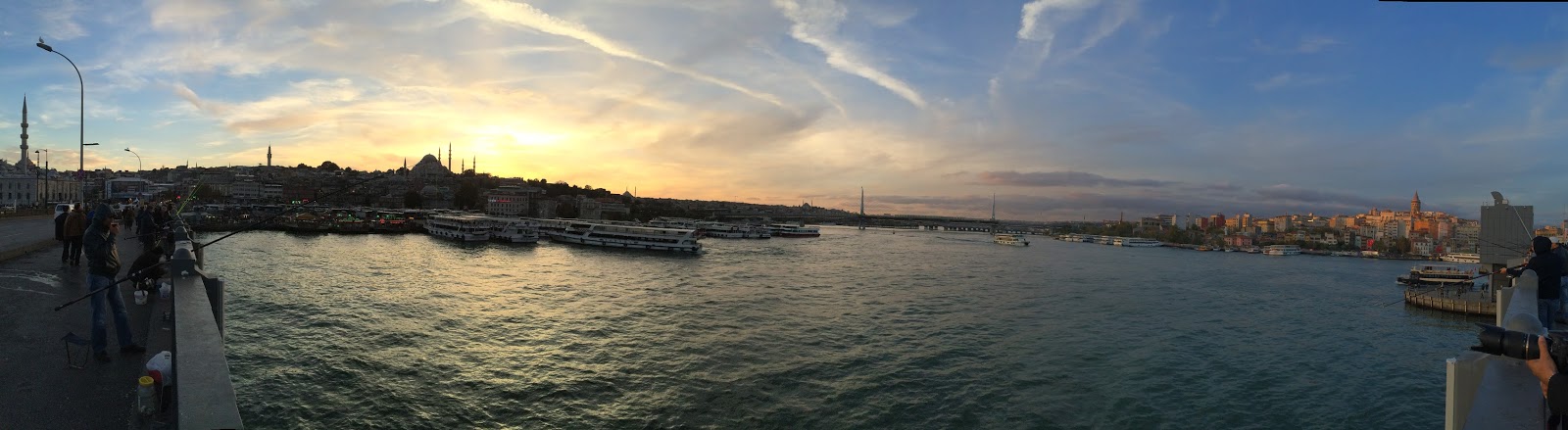
The old city at sunset

Savouring Turkish coffee: food and drink get their own blog as we tried so many different things

Love you all

Matt