October 21-25
Hello everyone!
With two weeks of holiday, lots of conversation at work has revolved around travel destinations. Some going to Europe, others jetting down to Panama or even the Galapagos. People therefore seemed confused when I would proudly announce that we were going to…San Miguel.
 |
| San Miguel volcano looming large in the background |
 |
| It is also called Volcan Chaparrastique |
For those without an extensive knowledge of this country’s geography, San Miguel is El Salvador’s third city and sits in the eastern part of the country, dominated by the eponymous volcano sitting to its western side. It is not known as a place to visit.
 |
| The straight line distance from Santa Tecla to San Miguel is about 120 km |
 |
The population of the San Miguel department is
estimated to be slightly over half a million |
What it does have is that volcano, dominating the sky and looking particularly spectacular from our AirBnB balcony. It is apparently a difficult climb, with lots of scree and not a lot of protection from the Sun. It is also apparently a dangerous climb, as it is an active volcano. How active? Well, it’s been a year…
 |
| Mini pondering whether she could run up the volcano |
 |
This is not the May 2023 eruption, just some clouds
throwing shapes as we watched from our balcony |
We were never going to climb that volcano. Why we were staying on the outskirts of San Miguel was to explore lots of lakes and lagoons in the surrounding area. Having arrived on Monday afternoon, we drove south to Jocotal on Tuesday, which I wrote about in the previous blog.
 |
| El Salvador's Okavango Delta! |
 |
| Laguna de Jocotal |
The plan for Wednesday was to drive an hour west to Laguna de Alegría, a volcanic lake which can turn green if the light is right, after stopping at some swimming caves nearby. It was a trip I’d been booked on at the end of August, but which got cancelled with less than 24 hours notice, so I was excited about our plan. I say ‘plan’ because, having packed the car with everything we needed, I tried to turn it on…
 |
| The problem was the starter motor - quite important |
This is not the car we regularly use. That car, a previously reliable Suzuki, conked out just over three weeks ago. This is the car I initially bought shortly after moving to El Salvador, which has probably taken years off my life through stress. It’s been working well of late, so we decided to use it for our trip. Working well until this moment…
 |
| The car insurance allows one free tow a year |
As it was, this tow truck took me into the centre of San Miguel for the first time. Maybe a chance for itself to show its sunnier side?
 |
| I spent a lot of time here - the car workshop... |
 |
Pollo Campestre, one of El Salvador's biggest fried chicken
chains, originates from San Miguel. They are everywhere. |
Poor word choice, there. It doesn’t need to be any sunnier. Or hotter. In those aforementioned chats about travel, people who have visited San Miguel before had two things to say:
Asking why on earth we were going there;
Telling us it was really, really hot.
They weren’t lying. The joke here goes that people from San Miguel, if they end up there for whatever reason, complain that Hell is too cold. That’s Hell, the place often depicted with roaring flames. It certainly felt hot.
 |
| I spent some time in this shopping centre. Mainly for the air conditiong. |
 |
| Hilariously, this Uber driver's temperature gauge said it was -38 outside! |
The mechanic shop in San Miguel, in tandem with my regular mechanic from San Salvador, were figuring out the problem. This gave me a bit of free time to walk around. A quick internet search had shown me that San Miguel has a ‘famous’ soup: sopa de mondongo. There was a ‘famous’ place nearby. I went there. I ate it. I will never do so willingly again. Pig skin, possibly some tripe, a bit of yucca…then it got weird. The strangest part was the piece of banana…with the peel still on…
 |
| One of the stranger soups I've eaten |
Upon my return, having sweated out most of the soup through walking, the mechanic told me that, as predicted, there was an issue with the starter motor. It would need fixing, and was being sent to an electrician. This gave me more time to explore, starting by walking to the main square.
 |
Random artwork, but my route didn't have many murals like
one would find in other towns in El Salvador |
It’s not much of a square. Not much of a cathedral either, if we’re being honest, though it does dominate said square. Next to it is the city hall, and opposite is…a China Wok. I got out my camera at this point to take some photos…and it wouldn’t turn on. Turns out it was too hot. San Miguel is very hot. At least my phone was working!
 |
The cathedral was completed in 1962...
100 YEARS after the first stone was laid |
 |
| The main square of San Miguel |
As I’m starting to walk back towards my wonderful car under a now thankfully cloudy sky, I get a phone call to say that there won’t be a fix today and to collect it tomorrow. With perfect timing, the heavens open. Nearby was a beer hall. I didn’t need a second invitation.
 |
| The water was also needed - I blame the soup |
Being determined to not spend the first week of my holiday sitting in an apartment waiting for a phone call, I looked into what I could do on the Thursday. As Hannah had to work, she kindly decided to keep the dogs with her at the AirBnB whilst I trekked away. Trekked is the right word, as I couldn’t find a bus to get on. I decided to walk 6 kilometres to get to the caves I hadn’t seen the day before: Cuevas de Moncagua.
 |
| Dreaming of being on a paddleboard |
 |
| Swimming pools in the Cuevas de Moncagua complex |
When I arrived, I was greeted by a closed gate and lots of sleepy stray dogs. It was at this point that I remembered why I had wanted to go on Wednesday; they do weekly maintenance of the complex on Thursdays. An hour’s walk to a place which was…shut.
 |
| Closed |
Well, it was until I asked if I could enter just to look at the caves, rather than swim. This was fine. The caves are quite small but with beautiful, linear colours in the rock which created them. Apparently you can’t actually swim in them, instead swimming in the nearby manmade pools. The water looked enticing, particularly after striding along in the ever-growing heat for an hour to get there. At least I’d been allowed in, I thought.
 |
| I think the rock is pumice |
 |
You can swim up to a certain point,
but not in the caves themselves |
From there, it was a slightly longer walk to see something else that had been on the list: Quelepa Ruins. They’re listed on Lonely Planet, so were probably worth a visit. The walk between the villages of Moncagua and Quelepa was worth it in itself, showing off some lovely countryside.
 |
| Tree-lined lanes reminded me of the UK |
 |
| A Salvadorean version of a canal? |
As I began to trample off-road, I became glad that I hadn’t tried to drive to the ruins. This became very clear when I found that I would have to cross a river. I asked a lady washing her clothes nearby, who gestured that it would reach knee-height. I’d come this far…
 |
| The path to the ruins |
This now felt like proper exploration. Following my map, I hooked a left through that unidentifiable gap you see in the picture below, before trampling through and over long grasses and plants. I had to avoid a large spider at one point as well.
 |
| My path, according to Google Maps |
 |
| Can you see the spider? |
Eventually, I came to my reward. You can look at this from a half-full or half-empty perspective. For the latter, you can hardly see anything. It just looks like a stone. Being more positive, however, this means that this is still pretty much undiscovered as a ruin, and that hardly any people have seen this memorial to pre-Hispanic history before.
 |
| The bottom of what is thought to be one of up to 40 terraced platforms |
 |
The site was inhabited by the Lenca tribe
between the second and seventh centuries |
I viewed it more optimistically, though admittedly was a bit underwhelmed. The week as a whole has been a bit underwhelming, unfortunately, due to circumstances outside of our control. As we rolled a rental car away from San Miguel, we reflected on a trip that hadn’t lived up to expectations. At least the rental car had air conditioning…
 |
| Cuevas de Moncagua |
 |
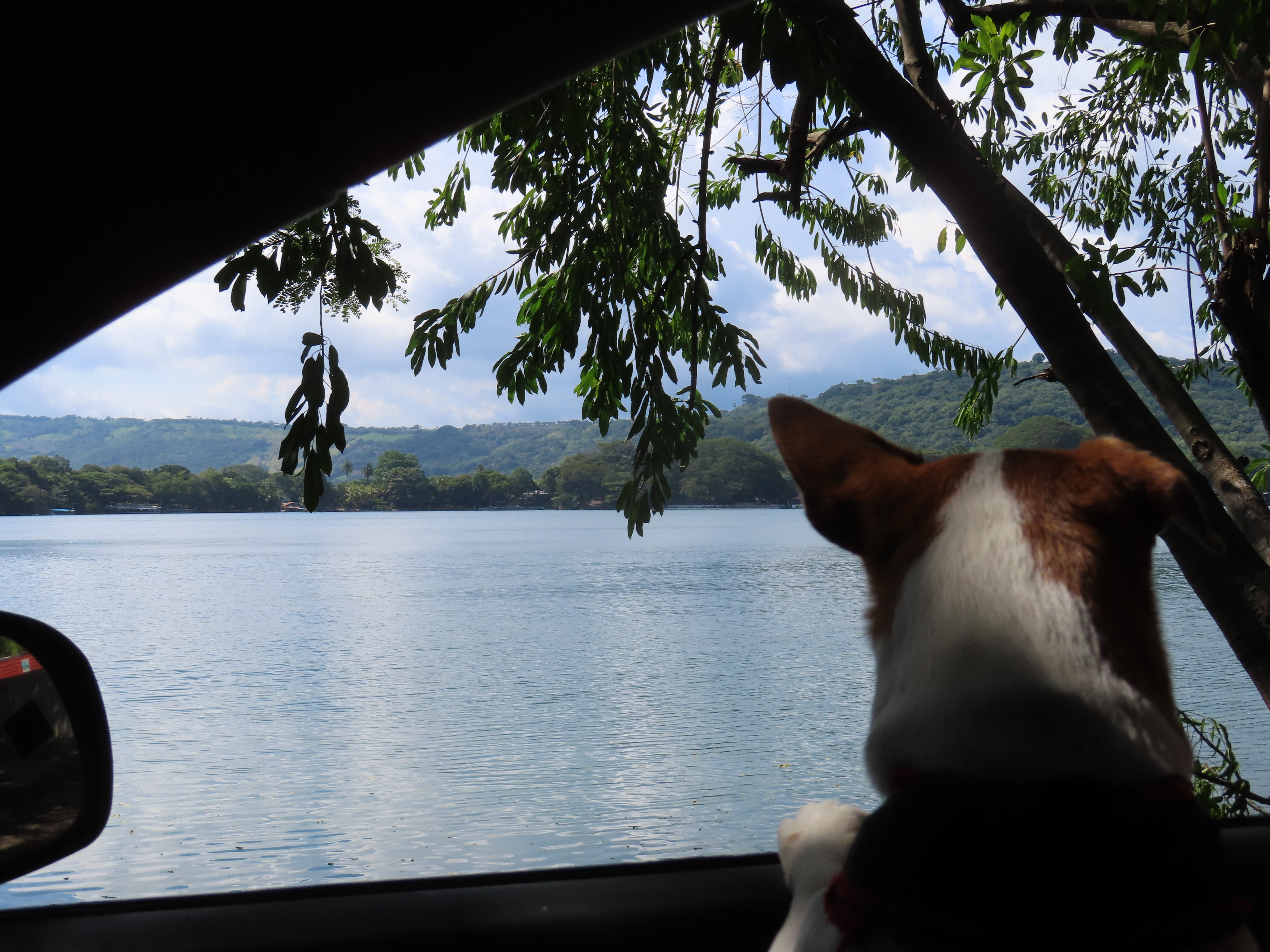
| Maxi showing the mood perfectly |
Extra note: The following Monday, I:
drove back to San Miguel - with the now-fixed part - in the rental car;
hung around for a bit whilst the part was installed;
started to drive back to Santa Tecla;
turned around and came back to San Miguel as the engine light was on;
after this was sorted, drove back to Santa Tecla in our car;
had a beer. A well-deserved, cold beer.
 |
| Oh, Frijoles |
Love you all,
Matt