Sunday, 29 October 2017

South Africa – Having a whale of a time!

October 20-21

Hello everyone!

The largest mammal.

Whale, whale, whale...what do we have here?

The heaviest mammal.

The fluke or tail helps to power the whale

The mammal which causes an almighty splash.


Welcome to Hermanus, an otherwise sleepy South African coastal village which hosts some very special visitors between June and November each year.


As the crow flies, Hermanus is about 300km west of Mossel Bay

Hermanus is the main stopping point on the Whale Coast Route

Southern Right whales – so called as they were the ‘right’ ones to poach back in the day – are huge. Growing up to 17 metres in length, one adult whale is almost equivalent to a lane at a bowling alley.

A model of a southern right whale

They make their way up from the Antarctic each winter (remember winter is June/July down here) to find shallow waters in which to mate.

Southern rights are also found in Australia and South America

We had been told by many South Africans that as it was the tail-end of the season, we may not see a whale. After arriving in Hermanus, we dumped our bags and headed to Walker’s Bay to see if we would have any luck.

The picturesque Walker's Bay

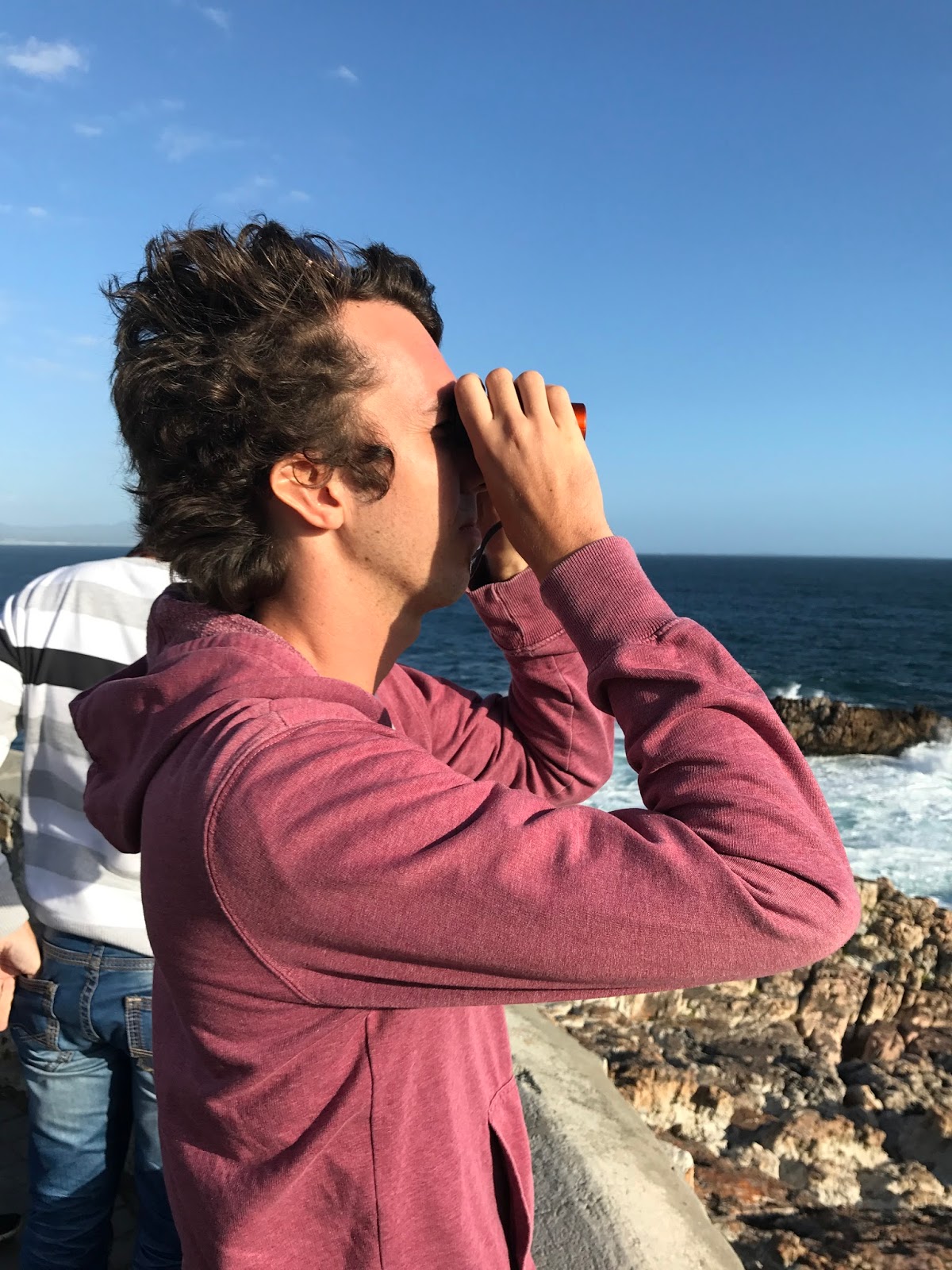
Being quite far off shore, binoculars are
often needed
Whales are huge; however, in comparison to the size of the oceans in which they reside, it can often be like finding the needle in the proverbial haystack. Add in the fact that their colour is generally black or a very dark blue, save for the white callosities on their heads, and you’ll come to realise that seeing a whale is not a guarantee.

A whale, captured with a long lens on a phone
That small white mark is the whale, showing
the distance between human and whale

It makes it that much more special when you do see one. About ten minutes after we started scouring the sea with binoculars, we noticed a commotion amongst a group of people on a nearby rock.

The vast majority of tourists come to Hermanus to watch
the whales from shore

The reason for the excitement was this…

Hermanus is apparently the best place to whale watch,
from the shore, in the world

In the distance to our left, a female whale had surfaced. Just briefly, but enough for us to be sure we were staring at a whale.

Part of a possibly seventeen metre body emerging from the ocean

It’s important to remember that they aren’t here for our entertainment. They will come up for air when necessary, not on a clockwork rotation.  Taking photos of them can thus be a challenge, particularly when they are so far away.

The whales are near the surface when
hunting for food

The Law of Sod naturally meant that the whale started to move away from the rock as soon as we got there and had a decent view.

The colder water supplies a higher
nutrient level of food

Luckily for us, the adult whale turned around and started making her presence more visible, and much closer to the shore.

The fluke of the whale, metres from shore

She firstly did this by plunging into the cold water, with her tail being flicked up so that it would enter vertically.

Whales come up to South Africa to mate

A Southern Right can have up to
seven mates

The whale then disappeared from sight. Pairs of eyes were fixed intently on the whale’s entry point into the Atlantic. We all knew what might happen next.

Looking for the whake

Without any warning, the colossal whale soared into the late afternoon sky, seemingly hanging in the air for a brief moment before crashing back to sea and once again disappearing from view.

Whales jumping out of the water
is known as 'breaching'

Researchers now believe this is
a form of communication

I was caught off-guard first three times, before finally capturing the moment on camera. This may have been because I was in such awe; how can a whale which weighs 40 tons propel itself out of the water?

Attempt one: whale off to the list

Attempt three (or four or five): timing

We tracked the whale around the craggy bay, watching her soar and splash.


Breaching is for distant communication,
which makes sense as no other adult whales were present

Finally, one last tail flick and she was gone. Out of sight, but certainly not out of mind. An incredibly brutal, beautiful animal to witness.

Whales will live between 50 and 100 years

Whales aren’t the only animals to be found in Hermanus. Many of the jagged rocks on the Western Cape are home to dassies, which look like gophers but are actually the closest living relative to the elephant. I’m not sure how, either.

Dassie...elephant...

A lot of their activity revolves around sleeping and eating
Further down the coast, at Betty’s Bay, a large colony of penguins can be found. The famous colony is located nearer Cape Town, at Boulder’s Beach. The upshot of this is that far fewer people visit the penguins at Betty’s Bay, making your time there much more pleasurable and relaxed.

The braying noise made by these cuties
has led them to be dubbed the 'jackass' penguin


Seeing all of these animals up close has been a highlight of this trip, particularly the Southern Right whale. I was really excited about seeing a whale; the experience certainly didn’t disappoint.

Walker's Bay

Free Willy

Love you all,


Matt

Tuesday, 24 October 2017

South Africa – Gazing the Garden Route

October 16-19

Hello everyone!

For most of our week in South Africa, we were based in the coastal town of Mossel Bay. Occasional high-rises loom over the enticing Indian Ocean breakers which lap the smooth sand. Not that we would be swimming; the number of great white sharks in this area is said to be quite high.

Santos Beach, in a cloudy Mossel Bay

We went straight...for about 2 metres, then
lay out our towels, quite far from the sea

The town is also often known as the entry point to the so-called ‘Garden Route’. It’s often described as a ‘must-see’ for people who visit South Africa, which is strange as it’s actually quite hard to pinpoint what is a ‘must-see’ aspect of it.

Major cities lie some way to the west (Cape Town) and east
(Port Elizabeth) of the Garden Route

Surfing is a popular attraction on the Garden Route,
even with the sharks
 The route stretches for about 300 kilometres eastwards along the southern coast. Having had the guided tour of Mossel Bay from our friend Nerina, we ventured out each day to find places of interest. Mainly beaches.

Wilderness

Knoetzie

A short drive from the main town along the route, George, is the wonderfully-named village of Wilderness. The change in the landscape is as stark as it is stunning. Thick forests tower above the water, just a few hundred metres away from the shore.

A fresh catch for lunch

It wasn't as warm as it looks - we had to sit behind a dune
for protection from the wind

That forest is, bizarrely, shaped like a map of Africa. If you squint. Just as impressive was the sight of paragliders negotiating the strong winds to land from the headland onto the beach below.

And the bit with no power...that's Malawi!

Two of these gliders seemed destined to crash at one point,
 though probably missed each other by a comfortable margin

The halfway point of the Garden Route is a sleepy town called Knysna. The area contains a lovely, calm lagoon.

Small boats moored around the pretty lagoon at Knysna

The calmness dissipates somewhat when you see the lagoon from above and observe where the water enters the lagoon. The ‘Two Heads’ guard the scenic town and showcase the power of the waves when they crash and clash against the rugged rocks.

Imagine a boat from 400 years ago trying to enter that...

The Heads are also described as 'the resting place of many
fishermen'. Lovely thought, that...

Near Knysna is a place called Knoetzie which I had seen recommended on a travel blog. It looked simple enough on Google Maps…

17 minutes, they said...try double that.

…whereas the reality was slightly different and unsuitable for our little Polo…

One of the smoother sections of gravel KP undertook

The township at the entrance

The beach itself, down a series of uneven, haunting steps, seemed abandoned. An old castle hung precipitously on the edge of the higher land above. A hidden treasure of a place, though a bit eerie.

Step through to find beach bliss...

Buildings are few and far between, not to mention unique
in architectural style

Exploring Knoetzie

I guess the allure of the Garden Route is the ‘route’: the journey. The allure is certainly strong, though we’d have enjoyed it more if the temperatures had been stronger as well.

A mountainous pass between Outdshoorn and George

Rolling down a hill from Wilderness, with a lagoon on the right

The views when driving are spectacular, just as they were when we were driving along Route 62 on our way to Mossel Bay. Once again, some lovely drives around this lovely landscape.

Windy, wavy and wonderful


Love you all


Matt

Wednesday, 18 October 2017

South Africa – The road to Oudtshoorn and its ostriches

October 15-17

Hello everyone!

South Africa is quite big – 3 times larger than Germany – so getting to a small, specific place can be quite tricky and time-consuming. The upshot is that the journey can be often as wonderful as the destination, bringing you closer to things you wouldn’t normally see.


Hannah’s friend, Nerina, lives near Mossel Bay, which is said to be one of the jewels of the Garden Route: South Africa’s well-known and frequently-visited southern coastline.


A beach at Mossel Bay
  
Getting to Mossel Bay from Malawi involves two flights (with three take-offs as the first plane collects passengers from Blantyre) and a long drive east from Cape Town.

Day 1: fly from Lilongwe to Cape Town via Jo'burg...

Day 2: drive from Cape Town to Oudtshoorn along Route 62
  
The route taken is a popular and stunning drive called ‘Route 62’, which takes your car up, down, through and around beautiful and diverse landscapes. We were driving to Oudtshoorn, a large provincial town, before heading to Mossel Bay.

A peak in Haweqwa Catchment Reserve, near the Winelands

A tunnel in Hawequas Mountain Area

A couple of stops were necessary to savour the beauty of the backdrops surrounding us. We parked at a wine reserve and café atop a hill near the village of Nuy. It seemed packed considering it was half past ten in the morning on a Sunday; I got the impression that places like this are the equivalent of village pubs in the United Kingdom, where families get together and spend a lazy morning or afternoon.

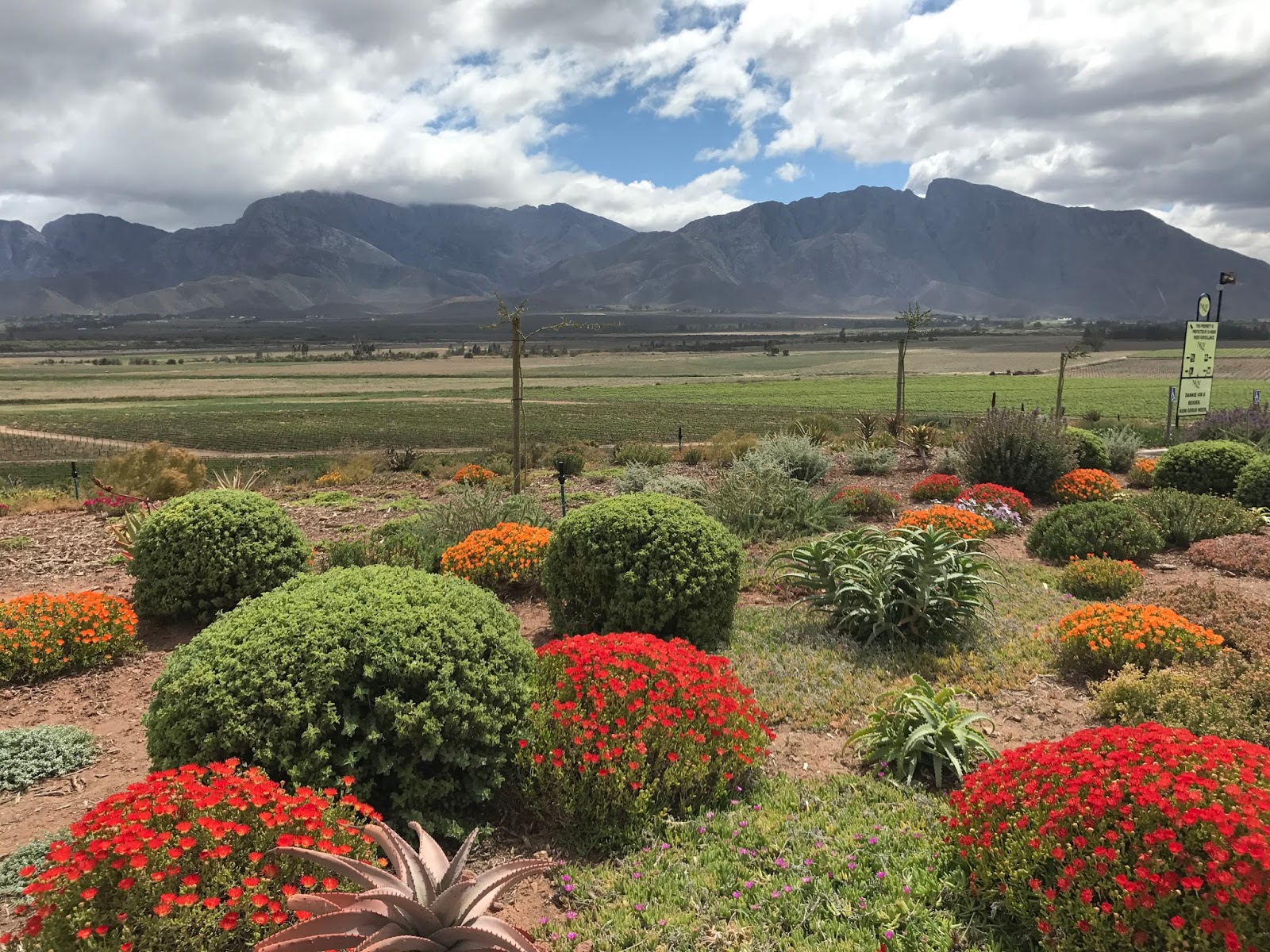
The view from Nuy Wine Reserve

French Twist, complete with bacon, cheese and fruit

Later down the stretch was a village called Barrydale, which was essentially a community of bed and breakfasts and cheap eats. One place full of character, not to mention calories, was an Americana joint called Diesel ‘n’ Crème. Sickeningly sweet and sumptuous shakes.

Could be Route 62, could be Route 66...

The Cruella de Ville: Belgian chocolate and
strawberry compote

 The sugar helped maintain alertness for the remainder of the drive to Oudtshoorn, though the soaring peaks of the cliffs and snaking roads through towering passes were worth staying awake for.

Mountains in the Klein Karoo

Coming down from the mountains towards Oudtshoorn

Oudsthoorn itself is unspectacular aside from hosting a massive amount of feathered friends.

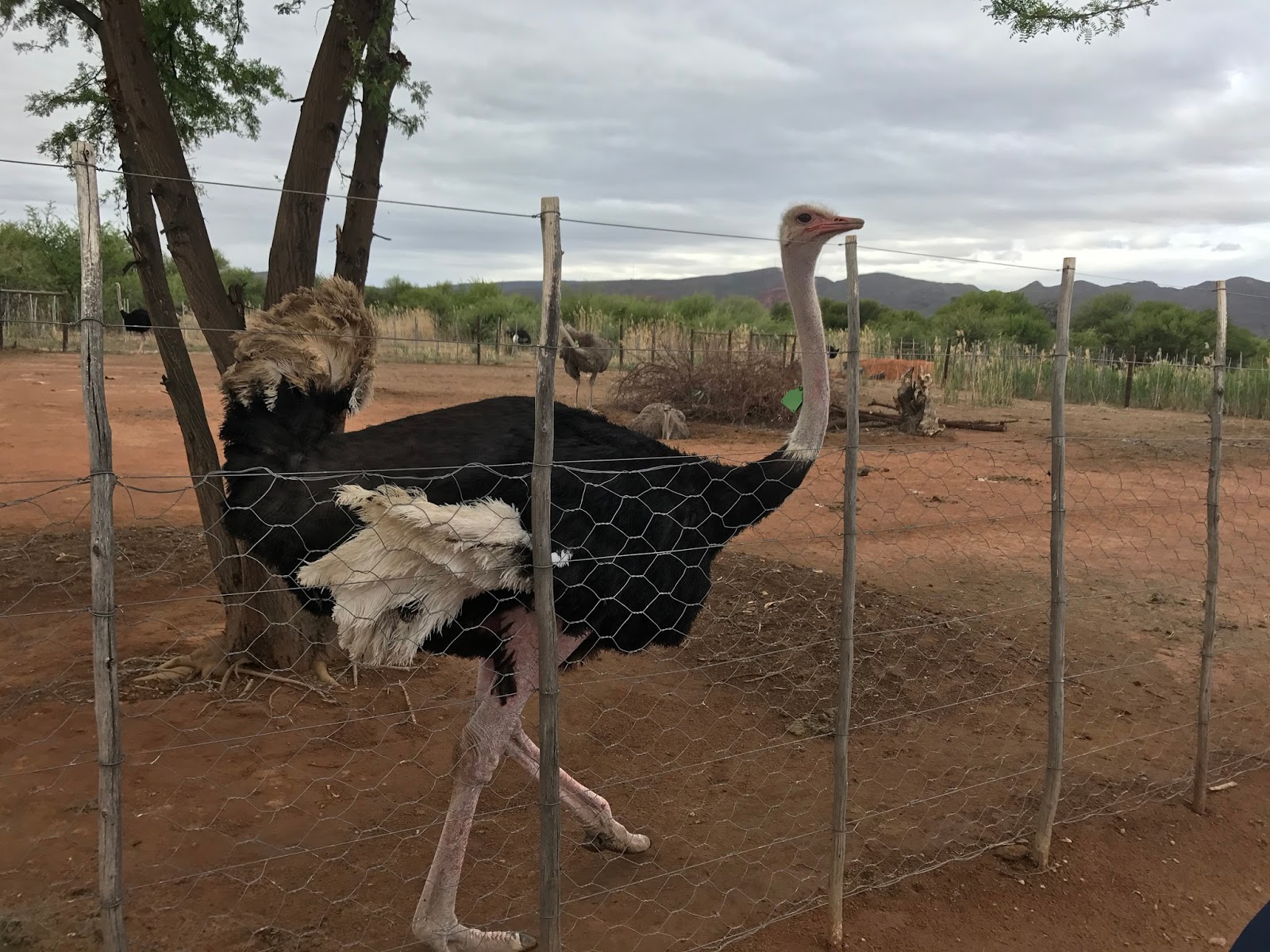
The largest and fastest bird in the world

Ostriches only have two toes - one to hold
them upright, and one for balance
  
There are quite a few ostrich farms in Oudtshoorn. Through friends of friends of friends, we were able to get a complimentary tour of the Safari Farm, which has three types of ostriches and a collection of emus from Australia.

This is the Kenyan Red ostrich, the most aggressive of the
three types

Emus are slightly smaller than ostriches

 Initially we walked around an enclosed section of the farm, which allowed us to balance on some infertile eggs and feed some of the hungrier birds.

These infertile eggs weigh about 1.5kg and
can hold over 200kg when horizontal


Later on we piled into a tractor and drove alongside the ostriches, whose curiosity brought them up close and personal with us.


That big toe can do a lot of damage

Finally, we were taken to a room where they showed us how they use the ostriches which they breed.

Ostrich leather is the second strongest around, after kangaroo
                
1kg of ostrich feathers used to be worth more than 1kg of gold
  
Most interestingly, we found that the males do a strange dance as a mating ritual.


As with many places in South Africa, Oudtshoorn’s ostriches were a pleasant surprise. The journey to find them, along the twists and turns of Route 62, was just as enjoyable and highly recommended.


Love you all


Matt